Abstract
The field-based assessment and management of biomechanical load, such as joint forces, in sports has high significance for effective athletic training and prevention of injuries. Developments in wearable sensors and machine learning have improved assessment methods, as they enable measurements in real training or competition environments outside the laboratory. This review systematically summarizes the current state of research on wearable sensors combined with machine learning for assessing biomechanical load in sports. Searches were conducted in PubMed and SPORTDiscus. A total of 5,426 articles were identified, of which 42 met the eligibility criteria after screening. Data were extracted on participant characteristics, sports and movement tasks, wearable sensors used, machine learning methods, model input and biomechanical output, validation strategies, and key findings. Running was the most frequently studied sport, although nine other sports were also investigated. Artificial neural networks and linear regression were the most commonly applied machine learning methods. Biomechanical load was most frequently assessed using ground reaction force metrics, followed by movement execution metrics and joint moment metrics. Current studies highlight that wearable sensors and machine learning can predict biomechanical loads, especially in the lower extremities during running. Expanding the diversity of sports studied and improving sensor placement on the upper extremities are necessary to broaden the application of wearable sensors and machine learning for athlete monitoring and injury prevention in real-world settings.
Keywords
biomechanics, sports, artificial intelligence, wearables, performance, training, injury risk
Introduction
The assessment and monitoring of musculoskeletal load is essential for effective athletic training and long-term health in sports (Camomilla et al., 2018). These efforts aim to identify deficiencies in movement execution, optimize performance, and reduce the risk of injury (Claudino et al., 2019). In recent years, interest in wearable approaches for assessing movement kinetics, such as ground reaction force (GRF) (Yılmazgün et al., 2025), has grown. This shift is driven by the limitations of traditional laboratory-based techniques, including optical motion capture systems and force plates, which, while accurate, are often costly, immobile, and impractical for use during training or competition (Lee & Lee, 2022).
Wearable sensors, such as inertial measurement units (IMUs), provide practical alternatives (Lee & Lee, 2022). These body-mounted devices are portable, relatively inexpensive, and non-invasive, making them well suited for field applications (Camomilla et al., 2018; Rattanakoch et al., 2023). However, converting the collected data into meaningful biomechanical metrics and interpreting the resulting large, high-dimensional time-series data presents significant analytical challenges (García-de-Villa et al., 2023; Stetter & Stein, 2024).
To address these challenges, machine learning (ML), such as artificial neural networks (ANNs), have gained increasing attention (Ferber et al., 2016; Halilaj et al., 2018; Stetter & Stein, 2024). These data-driven models can learn the relationships between wearable sensor inputs and biomechanical outputs without requiring explicit knowledge of the underlying biomechanical models (Ancillao et al., 2018; Wouda et al., 2018). This ability is particularly valuable in settings where direct biomechanical measurements are impractical or unavailable (Verheul et al., 2020; Xiang et al., 2022).
Research in sports-related ML has expanded rapidly, with no sign of declining interest (Dindorf et al., 2024; Zhou et al., 2025). Recent reviews have highlighted ML applications in athletic performance prediction and movement classification using wearable sensors (Claudino et al., 2019; Cust et al., 2019), but relatively few have focused on biomechanical load assessment in field settings in different sports. As an example, Xiang et al. (2022) reviewed ML techniques for lower limb running biomechanics but did not extend their analysis to broader sporting contexts or sensors beyond IMUs. In addition, Verheul et al. (2020) emphasized a persistent gap in field-based biomechanical load assessment, particularly at joint and tissue levels, and identified ML as a promising approach to address this challenge.
Accordingly, this review systematically summarizes the current state of research on wearable sensors and ML for field-based biomechanical load assessment across diverse sports. Specifically, it examines the sports and movement tasks studied, the types and placements of wearable sensors used, the ML approaches applied, and the biomechanical load metrics assessed.
The novelty of this review lies in its broad, cross-sport perspective. In contrast to previous work that has focused primarily on running and lower-limb biomechanics (e.g., Xiang et al., 2022), the present study considers field-based applications across a wide range of sports and do not restrict the analysis to a single sensor modality. This cross-sport, sensor-inclusive scope enables what is, to our knowledge, the first structured overview of current knowledge on wearable sensors and machine learning for field-based biomechanical load assessment in sports. By jointly analyzing study designs, sensor types, ML approaches, and target load metrics, this review reveals cross-sport trends and methodological gaps, thereby providing a basis for transferring methods across sports and making informed choices for future research, particularly in under-represented sports.
Methods
Search strategy
The PubMed and SPORTDiscus databases were used to identify relevant studies. Initial searches were conducted on December 9th, 2023 and the search was rerun on March 7th, 2025. Relevant studies were identified using keywords reflecting four main categories (Table tbl. 1): wearable sensors, machine learning, biomechanical load metrics, and sports.
Category | Search terms |
|---|---|
Wearable sensors | ("field based" OR "in the field" OR "in field" OR "field-based" OR field OR "wearable sensor" OR wearable* OR portable OR worn OR cloth* OR "body mounted" OR mobile OR IMU OR "inertial measurement unit" OR "inertial sensor" OR "inertial motion capture" OR acceleromet* OR gyroscope* OR magnetomet* OR MARG OR "magnetic angular rate and gravity" OR electromagnetic OR EMG OR electromyography OR "electronic skin" OR insole OR "in-sole" OR “plantar pressure”) |
AND | |
Machine learning | ("machine learning" OR "deep learning" OR "supervised learning" OR "unsupervised learning" OR "semi-supervised learning" OR "reinforcement learning" OR "support vector machine" OR "random forests" OR "bayesian learning" OR "decision tree" OR "artificial neural network" OR "artificial intelligence" OR "neural network" OR SVM OR AI OR ANN OR CNN OR RNN OR "convolutional neural network" OR LSTM OR "long short-term memory" OR clustering OR “k-means clustering”) |
AND | |
Biomechanical load metrics | (kinetic* OR load* OR moment* OR torque* OR force*) |
AND | |
Sports | (basketball OR gymnastic* OR skiing OR archery OR swim* OR athletics OR badminton OR baseball OR handball OR volleyball OR biathlon OR bobsleigh OR boxing OR breaking OR Canoe* OR cricket OR curling OR cycl* OR diving OR equestrian OR fencing OR skat OR football OR futsal OR golf OR hockey OR judo OR karate OR lacrosse OR luge OR "modern pentathlon" OR "nordic combined" OR rowing OR rugby OR sail* OR shoot* OR skateboard* OR skeleton OR snowboard* OR climb* OR squash OR surf* OR tennis OR "table tennis" OR taekwondo OR trampoline OR triathlon OR "water polo" OR weightlifting OR wrestling OR running OR biking OR bicycl* OR bmx OR soccer OR athlete* OR sport* OR training OR exercise) |
NOT pathology NOT animals NOT “physical activity” |
The asterisk (*) after the initial letters expands the search to include all terms beginning with those letters. Quotation marks (" ") specify that the words must appear together in the exact order.
The search string was formulated using Boolean operators by combining search terms with “OR”, each representing one of the main categories, to ensure that at least one of the terms was included. The sub-terms were joined with “AND” to cover the four main categories, and the operator “NOT” to completely exclude certain aspects from the search. The search in PubMed was carried out in the “All fields” area and in SPORTDiscus via the provider EBSCO in the standard setting. The studies identified were placed into EndNote 20 (Clarivate) to remove duplicates and to perform screening.
Eligibility Criteria
The search was limited to English-language articles, and review papers were excluded. The search terms were designed to exclude studies that focused on medical conditions, animal participants, or general physical activity unrelated to sport-specific contexts. This list also served to quantify the diversity of sports represented in the included studies. Studies that only assessed gait were excluded; however, studies in which gait was one of several movement tasks were included. The criterion for wearable sensor usage was considered met if the measurement technology used as input for the ML model was worn on the participant’s body. Load metrics were restricted to biomechanical quantities only. In addition to metrics directly specified in our search terms, we also report related metrics (e.g., joint angles) that emerged within the included studies to provide a clearer contextual representation of load metrics (fig. 5). Physiological aspects of training load, such as metabolic performance, oxygen uptake, cardiovascular demand, or perceived exertion (Vanrenterghem et al., 2017), were excluded.
Data Extraction
Data were extracted on the methodological characteristics of each study and summarized in tabular form. Extracted information included the type of sport examined, the specific movement tasks analyzed, and participant characteristics such as age, gender, and performance level relevant to the sport. Details of the wearable sensors were also recorded, including sampling frequency, the number of sensors used, and their placement on the body. Information on the ML methods was also extracted, covering key aspects of model architecture.
A separate table summarizes the input data used for ML model training and evaluation, the corresponding biomechanical outputs, and the systems employed to provide ground truth references, used for both the ML model building and performance evaluation. This table also includes the proportions of training and test datasets, the evaluation metrics applied, and the main findings reported in each study.
Results
Search Results
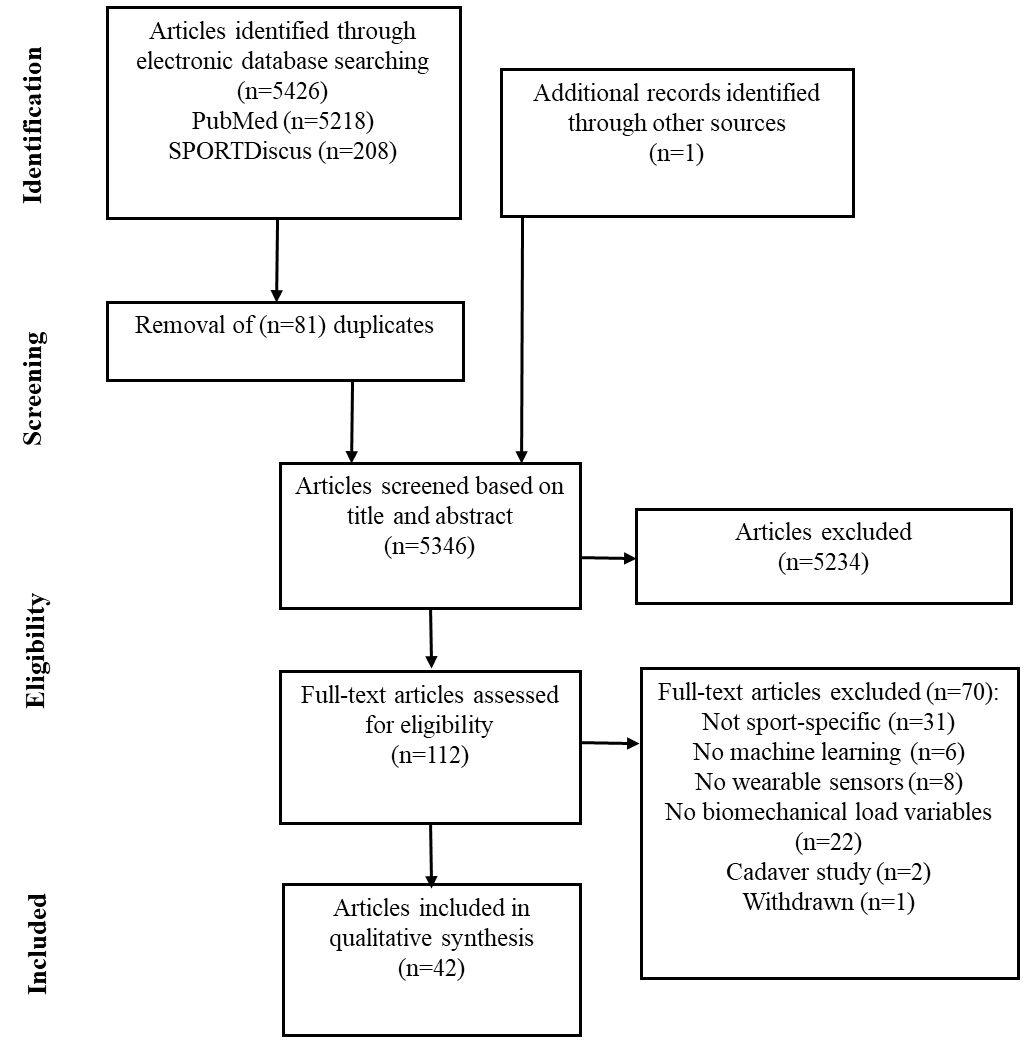
The search is presented in Figure fig. 1. A total of 5,426 articles were identified, of which 5,218 were in PubMed and 208 in SPORTDiscus. The removal of duplicates left 5,346 articles, which were supplemented by Hernandez et al. (2021), found in the reference list of the study by Xiang et al. (2023). After screening the titles and abstracts, 112 studies remained that were subject to full-text screening. This led to the exclusion of 70 studies, for reasons such as no ML or wearable sensors used, no biomechanical load metrics considered, the movement task did not meet the inclusion criteria, or cadavers were investigated. A final total of 42 studies were included.
Participant Characteristics
Nineteen studies included both women and men in comparable proportions, while 16 studies focused exclusively on male participants and six studies exclusively examined female participants. One study did not specify gender (Table tbl. 2). The mean age of participants ranged from 13.2 ± 0.5 to 35.9 ± 9.2 years. Sample sizes varied widely, from 1-133 participants, with nine studies comprising fewer than 10 participants. The mean sample size was 26 ± 27 participants. Eleven studies did not specify the performance level of the participants in relation to the sport examined. In 21 studies, participants engaged in the sport as part of university activities or during their leisure time. Furthermore, four studies intentionally included participants with diverse levels of experience (Bogaert et al., 2024; Hendry et al., 2020; Joo et al., 2016; Krumm et al., 2021).
Investigated Sports and Movement Tasks
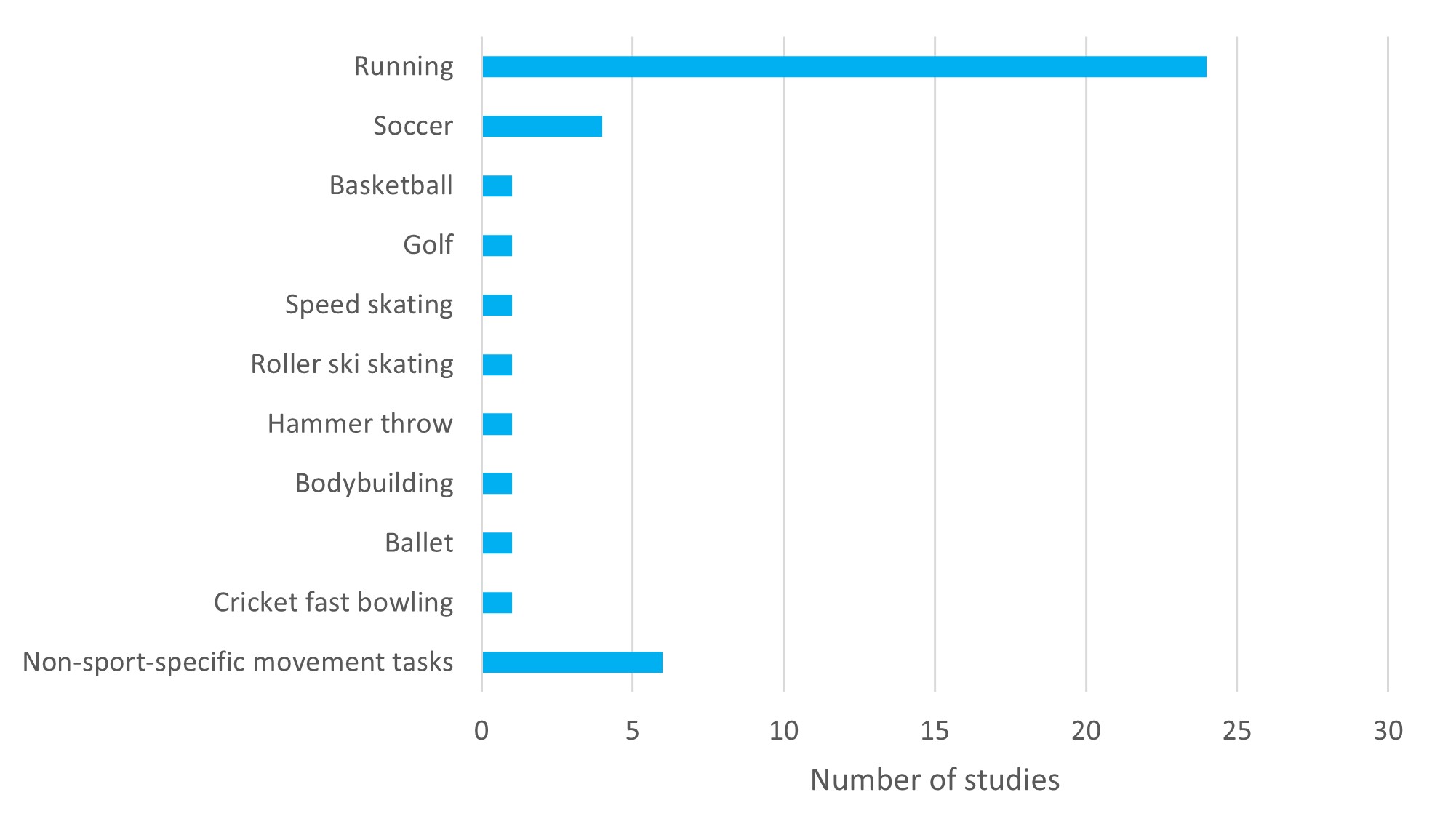
Running was the most frequently investigated sport, featured in 24 studies (fig. 2). This was followed by sport-unspecific movement tasks, examined in six studies, which included typical movements found in game sports, such as cutting maneuvers, turning movements, and jumps. Soccer was the focus of four studies. Eight other sports were each examined in a single study.
Wearable Sensor Types and Locations
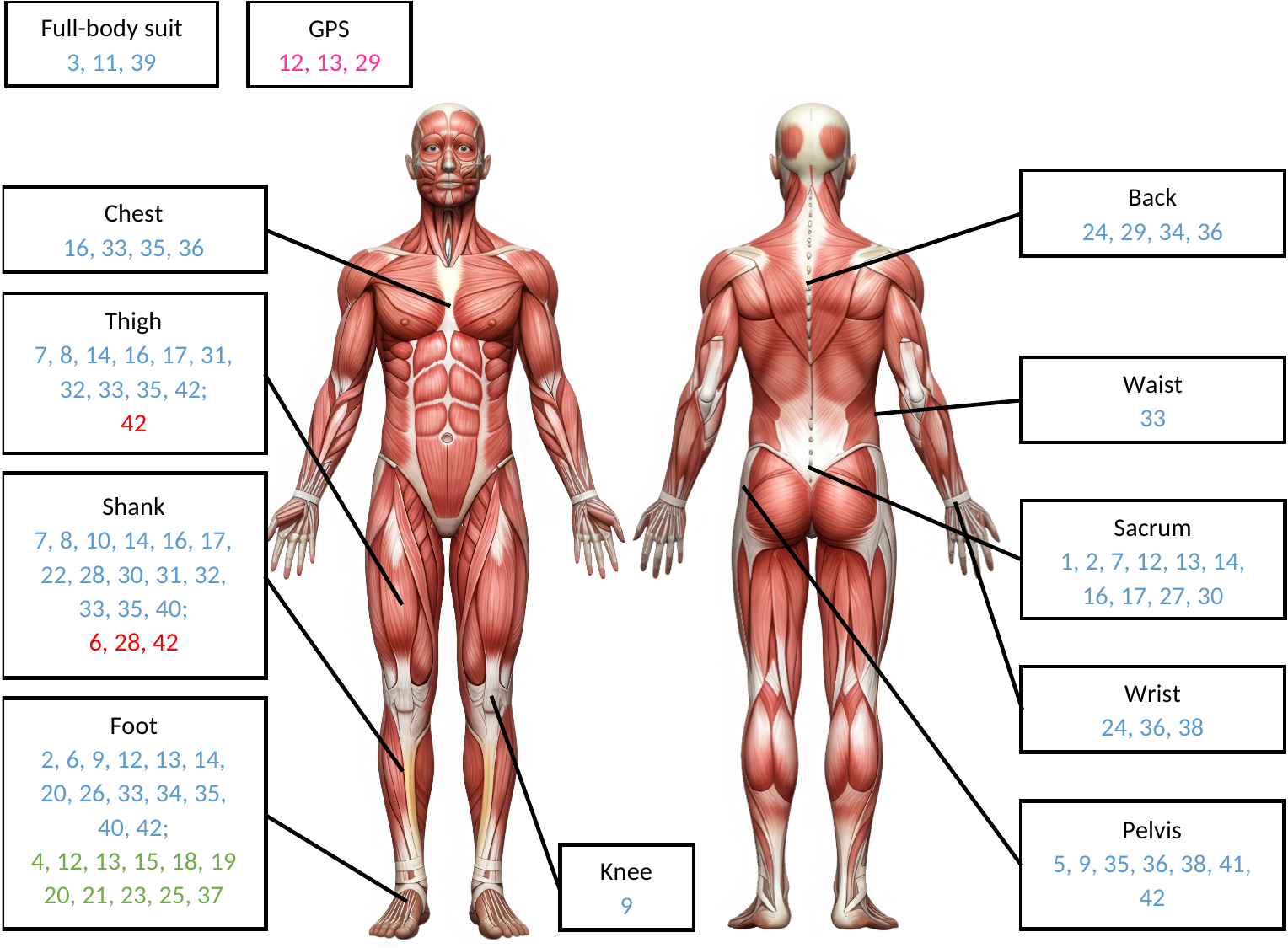
IMUs were the most commonly used wearable sensors, appearing in 25 studies, followed by plantar pressure insoles (11 studies), surface EMG (3 studies), and GPS devices (3 studies) (Figure fig. 3). IMUs were most frequently placed on the lower leg, followed by the foot, thigh, sacrum, and pelvis. EMG electrodes were applied to the thighs and/or shanks (Figure fig. 3).
Nr. | References | Participants (female/male) | Age (years) | Participant characteristics | Sports | Movement tasks | Number of sensors | Sensor type | Sensor locations |
|---|---|---|---|---|---|---|---|---|---|
1 | 37 (24/13) | 20 ± 2 | Healthy student cross-country runners | Running | Treadmill running at 3.8, 4.1 and 5.4 m/s (males) and 3.8 and 4.9 m/s (females) | 1 | 3D-accelerometer | Sacrum on a waistband | |
2 | 19 (9/10) | 29 ± 9 | NR | Running | 30 x 30s running:
| 3 | 2D-accelerometer | Sacrum, two on the right shoe only for foot strike pattern detection | |
3 | 32 (32/0) | 15 ± 1 | Talented soccer players from a regional talent training program | Soccer | Unanticipated sidestep cutting movements (40–50° change in direction) | 17 | 3D-IMUs | Full-body | |
4 | 4 (1/3) | 19-27 | Professional middle-distance runners in the national top 10 ranking | Running | Distance of 60m at speeds of 5-7 m/s (personal average speed in competition) | 4 in one sole | Plantar pressure insoles | Left foot | |
5 | 33 (12/31) | NR | Runners with varying experience and sports engagement | Walking and running | Treadmill running at 2.22, 2.50, 2.78, 3.33 m/s, self-reported preferred speed for a 5,000 m run, preferred speed–0.14 m/s, preferred speed +0.14 m/s | 1 | 3D-accelerometer | Pelvis | |
6 | 12 (4/8M) | 25 ± 3 | Healthy people | NR | Standing still, standing on tiptoes (two legs and one leg), calf raises with 2 s per cycle (two legs and one leg), level walking on treadmill (1.0, 1.3, 1.6 and 1.8 m/s), level running on treadmill (2.0, 2.3 and 2.6 m/s) | 1/5 | 1D-accelerometer/ EMG | Above the left Achilles tendon / on the left calf, on the left shin | |
7 | 11 (5/6) | 23 – 29 | Healthy amateur athletes and people with an active lifestyle | NR | 10 maximum vertical drop jumps (30 cm box height) | 3 | 3D-IMUs | Sacrum, thigh, lower leg | |
8 | 25 (25/0) | 20 ± 1 | Healthy people with moderate physical activity at least 3 x 30 min per week | NR | 8 forward jump landings from a 30 cm high box (max. vertical jump immediately after landing) | 4 | IMUs (2D-accelerometer) | Right and left upper and lower legs | |
9 | 12 (0/12) | 23 ± 1 | Runners with no recent history of lower-limb injuries | Running | Running at five different speeds (8, 10, 12, 14 and 16 km/h) | 4 | 3D-IMUs | Hip, knee, ankle and foot | |
10 | 93 (38/55) | 35 ± 11 (female), 36 ± 9 (male) | Healthy people with a minimum running distance of 15km/week | Running | 13 rearfoot runners running a distance of 30m with speeds of 2.55 m/s, 3.20 m/s, 5.10 m/s and preferred running speed 80 people running with any foot strike pattern) a distance of 30m at 3.20 m/s | 2 | 3D-accelerometer | Left and right shin | |
11 | 24 (24/0) | 15 ± 1 | Talented female soccer players | Soccer | Laboratory task: 5m run-up, then one-footed landing with dominant leg and change of direction of 40-45°, then run through a goal 5m away Field tasks (during training sessions):
| 17 | 3D-IMUs | Full-body | |
12 | 16 (8/8), exclusion of 3 participants due to GPS problems | 23 | NR | Running | 5 mile run on the University campus and surrounding parks |
| 3D- IMUs/plantar pressure insoles/GPS-watch | Back of each foot, sacrum / one per foot / on the wrist | |
13 | 15 (6/9) | 24 | NR | Running | 4 or 5 speeds over a distance of 400m (fastest pace optional; speed range 2.33-5.36m/s based on 5km pace of participants) |
| 3D- IMUs/plantar pressure insoles/GPS-watch | Back of each foot, sacrum / one per foot / on the wrist | |
14 | 10 (0/10) | 27 ± 3 | NR | NR | 10 attempts each:
| 7 | 3D-IMUs | Lower back, right thigh, lower leg and right foot | |
15 | 16 (7/9) | 25 ± 3 | NR | Walking and running | Two test sessions one week apart:
| 2 | Plantar pressure insoles | One per foot | |
16 | 23 (23/0) | 19 ± 2 | Healthy dancers with recreational and pre-professional level | Ballet |
| 6 | 3D-IMUs | Thoracic spine, sacrum, and left and right thigh and shank | |
17 | 27 (0/27) | 27 ± 4 | NR | Walking and running | Treadmill walking and running starting at 4 km/h with a constant increase of 0.16 km/h every 2 seconds until the target speed:
| 5 | IMUs (1D- accelerometer) | Sacrum and both upper and lower legs | |
18 | 18 (9/9) | 28 ± 5 | Recreational runners | Walking and running | Treadmill walking and running:
| 2 | Plantar pressure insoles | One per foot | |
19 | 80 (39/41) | 28 ± 7 | Professional and amateur golfers | Golf | Five golf swing movements | 99 sensors per insole | Plantar pressure insoles | One per foot | |
20 | 7 (1/6) | 34 ± 11 | Speed skaters with different experience levels | Speed skating | Speed skating imitation exercises on slide board (five complete push-off phases per leg) |
| 3D- accelerometer/plantar pressure insoles | Both ankles/one per foot | |
21 | 9 (2/7) | 23 ± 2 | Healthy people | Running (in-place) | Alternately lifting the legs following an audio file with a moderate, steady “one-two, one-two” to simulate running in place | 2 insoles, 8 sensors per insole | Plantar pressure insoles | One per foot | |
22 | 4 (0/4) | 21 ± 2 | Healthy collegiate basketball players | Basketball | Various basketball-specific tasks: walking, jogging, running, sidestep cutting, max-height jumping, stop-jumping | 1 | IMU | Right distal medial tibia | |
23 | 40 (0/40) | 13 ± 1 | Soccer players | Soccer | Soccer-specific tasks: two-legged jumps over 30cm hurdles, zigzag run around four poles, sideways sprint, sprints with 90° cutting maneuver, maximum sprints | 64 sensors per insole | Plantar pressure insoles | One per foot | |
24 | 18 (0/18) | 19 ± 1 | Sub-elite cricket fast bowlers | Cricket fast bowling | 36 throws from the line, 12 throws per intensity zone: low = 70%, medium = 85%, high = 100% of the maximum perceived bowling effort | 2 | IMUs (each with a different accelerometer) | T1 vertebra and on the bowling wrist | |
25 | 30 (0/30) | 34 ± 7 | Recreational runners | Running | Running at a comfortable speed (2.7 ± 0.4 m/s) over a straight 5 m course with 6 different foot strike pattern types: natural, extreme-forefoot, forefoot, midfoot, rearfoot, extreme-rearfoot | 2 | Plantar pressure insoles | One per foot | |
26 | 7 (0/7) | 21 ± 1 | NR | Running | Treadmill walking at 4 km/h and running at 8, 9 and 10 km/h | 1 | IMU (1D-accelerometer) | Centrally on top of the right shoe | |
27 | 100 (27/73) | 29 ± 7 (female), 30 ± 8 (male) | Recreational runners | Running | Treadmill running in random order at 9, 11, 13 km/h | 1 | IMU | Sacrum | |
28 | 133 (56/77) | 18 – 65 | Recreational runners | Running | 8.5-min running at self-selected speed | 1/1 | EMG/3D-accelerometer | Gastrocnemius medialis | |
29 | 15 (5/10) | 23 ± 1 | Running team athletes | Running | Accelerating, decelerating and constant running tests on flat ground: 2 to 8 m/s with increments of 1 m/s | 1 | 3D-accelerometer with GPS | Back | |
30 | 44 (25/19) | NR | Competitive collegiate distance runners | Running | Treadmill running at multiple speeds with at least 60 steps (approximately 15 seconds): females at 3.8 and 4.9 m/s, males at 3.8, 4.1 and 5.4 m/s | 3 | 3D-IMUs | Sacrum, left shank and right shank | |
31 | 13 (0/13) | 26 ± 3 | Healthy sports students | NR | 6 tasks at self-selected speed: walking straight, 90° walking turn, moderate running, fast running, 90° running turn, 45° cutting maneuver | 2 | 3D-IMUs | Integrated into the knee sleeve (thigh and shank) | |
32 | 13 (0/13) | 26 ± 3 | Healthy sports students | NR | Sports-specific tasks: moderate running, fast running, 90° turns, sprint start, full stop after sprint, left/right cutting maneuver, lateral shuffle cut, walking, walking 90° turns, single-legged horizontal jumps, two-legged vertical jumps | 2 | 3D-IMUs | Integrated into the knee sleeve (thigh and shank) | |
33 | 16 (0/16) | 23 ± 1 | Healthy people | NR | 30 two-legged and 15 one-legged drop landing tasks from 30 cm height | 8 | 3D-IMUs | Chest, waist, upper and lower legs and feet | |
34 | 16 (7/9) | 23 ± 2 | Healthy recreational runners | Running | Running in four conditions in randomized order: two types of shoes (minimalist and standard shoes, 2.4 and 2.8 m/s, each with 100 steps each with forefoot, midfoot and rearfoot striking patterns | 1 | IMU | Back of the left shoe | |
35 | 15 (7/8) | 24 ± 1 | Healthy recreational runners | Running | Running in four conditions in randomized order: two types of shoes (minimalist and standard shoes, 2.4 and 2.8 m/s, each with 100 steps each with forefoot, midfoot and rearfoot striking patterns | 1 to 5 | IMUs (3D-accelerometer) | Chest, pelvis, left thigh and lower leg and left foot | |
36 | 13 (0/13) | 25 ± 3 | Healthy professional skiers | Roller Ski Skating | Roller ski skating with elite roller skis on a treadmill on two consecutive test days: Day 1: 12 submaximal units of 4 minutes each at a constant speed and three different sub-techniques with four different intensities (inclinations & speeds), then a maximum step test until exhaustion Day 2: two 21-minute stages (first low intensity, then at competition intensity) with freely chosen technique over terrain profile, then immediately step-by-step all-out test until exhaustion | 7 | IMUs (3D-accelerometer) | Upper back, chest, lower back, both wrists and both ski bindings | |
37 | 19 (0/19) | 24 ± 4 | Runners free of musculoskeletal injuries | Running | Treadmill running at 2.78, 3.00, 3,33, 4.00, 5 m/s, four slopes (-6°, -3°, 0°, 3°, 6°), with different step frequencies (lower, higher), and forward trunk lean | 2 | Plantar pressure insoles | One per foot | |
38 | 1 (0/1) | NR | University athletes | Hammer Throw | Hammer throws | 2/1 | IMUs/Load cell | Wrist, hip/hammer handle | |
39 | 8 (0/8) | 25 ± 5 | Healthy experienced runners | Running | Treadmill running at 10, 12, 14 km/h | 17 | 3D-IMUs | Full-body | |
40 | 32 | 26 ± 3 | Recreational runners | Running | 10 km run at 11.2 ± 1.2 km/h, before and after determining the foot posture index | 4 | 3D-IMUs | Dorsum of the right foot and on the anteromedial tibia | |
41 | 13 (13/0) | 24 ± 3 | Soccer players from elite clubs in the first and second leagues of Italy | Soccer | 5m shuttle run test at average speed of 70% of the respective maximum aerobic speed (2.5 ± 0.2 m/s) until exhaustion | 1 | IMU (3D-accelerometer) | Pelvic | |
42 | 19 (0/19) | 25 ± 5 | Healthy and well-trained bodybuilders | Bodybuilding | 5 squats each without load, then with 60%, 80% and 100% of the personal 5RM (maximum execution of 5 repetitions) | 8/5 | IMUs/EMGs | Feet and thighs and on the pelvis/front and back thigh, calf and shin of the right leg |
NR: not reported in the study.
ML Approaches
The most commonly-used ML approaches were ANNs (16 studies), followed by linear regression (14 studies) and long short-term memory networks (10 studies) (fig. 4, Table tbl. 3). In nine studies a deep learning approach was used. Random forest and support vector machines were used in seven studies each. Among unsupervised ML, principal component analysis (PCA), hierarchical clustering, and k-means clustering were used in four, three, and one study, respectively.
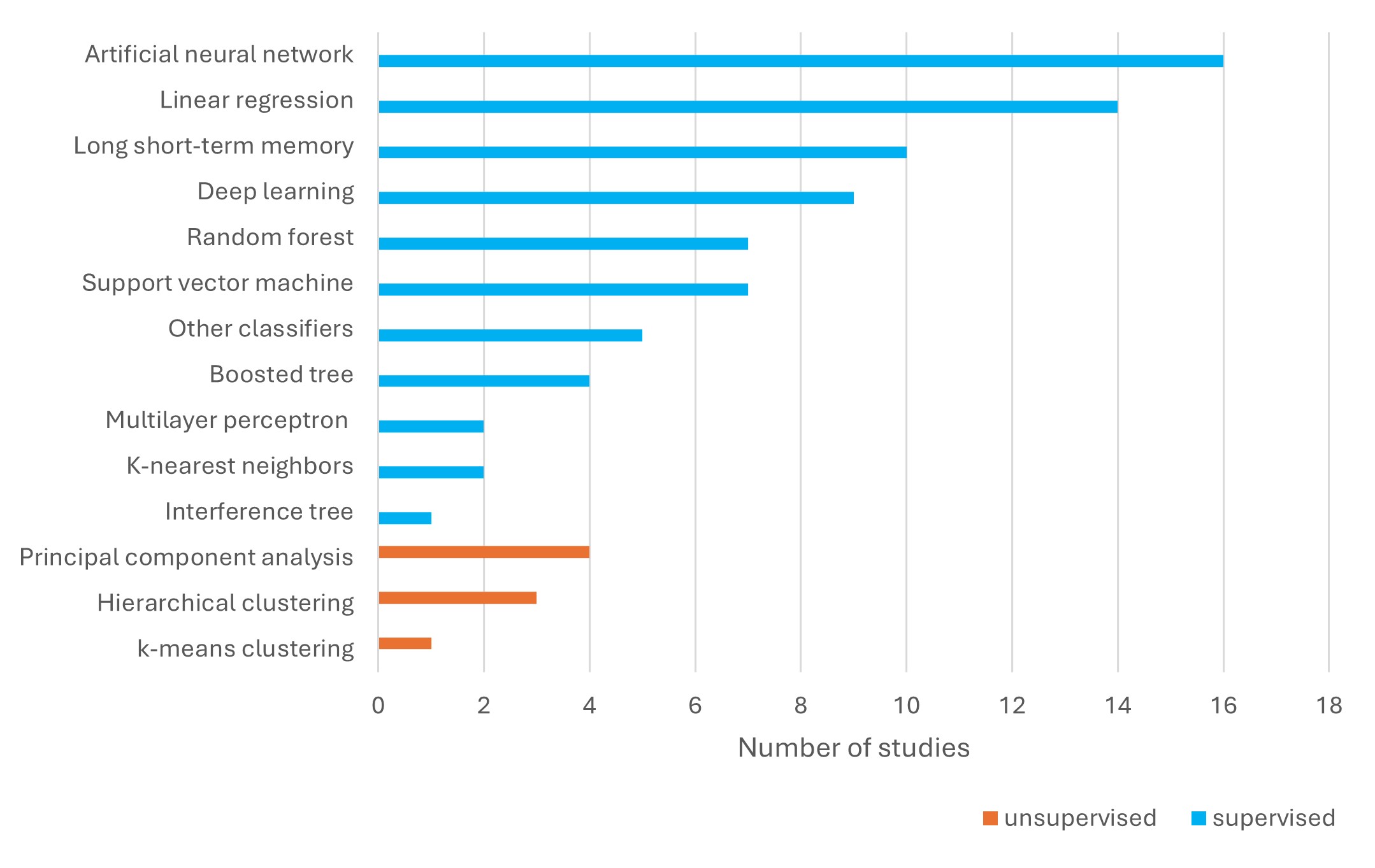
Blue bars represent supervised machine learning approaches, while orange bars show unsupervised machine learning approaches.
Biomechanical Load Metrics
Biomechanical load was most frequently investigated by GRF metrics (29 studies; fig. 5, Table tbl. 3). Movement execution metrics were the next most commonly analyzed variables, appearing in 10 studies, followed by joint moment metrics, investigated in nine studies (fig. 5, Table tbl. 3). In addition, joint angle, joint force, mechanical performance and EMG metrics were examined (fig. 5, Table tbl. 3).
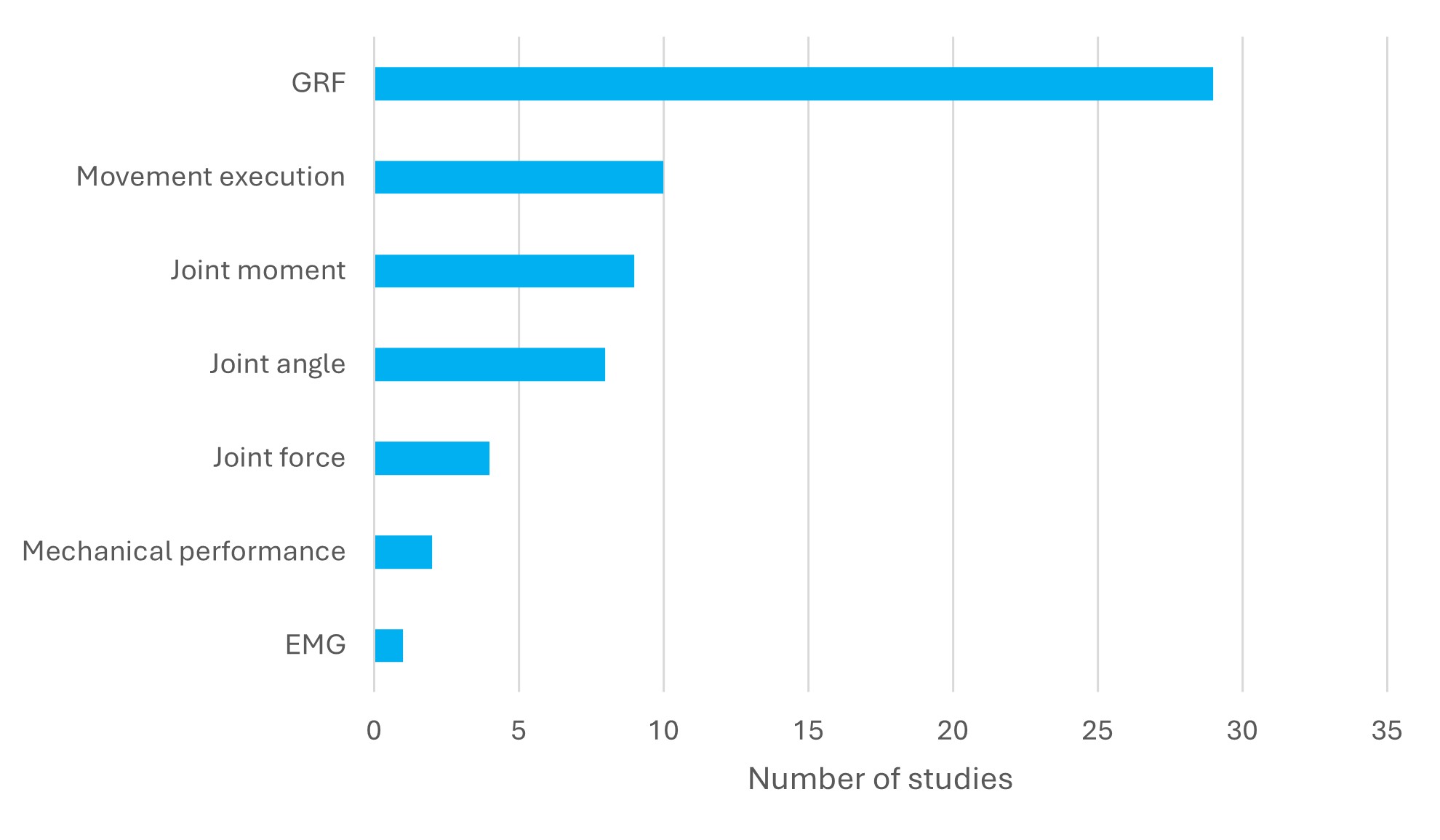
Examples for the categories are: GRF metrics: loading rate, movement execution metrics: contact time, joint moment metrics: ankle moment, joint angle metrics: knee flexion angle, joint force metrics: knee joint force, mechanical performance metrics: mechanical power, EMG metrics: sum of calf EMG magnitude. GRF: ground reaction force; EMG: electromyography.
Nr. | Reference | ML approach | Input | Dataset split | Validation | Biomechanical output | Evaluation | Reference data | Key findings |
|---|---|---|---|---|---|---|---|---|---|
1 |
| Acceleration data, running speed, stride frequency, body mass | Training/test: 19/9 participants | 5-fold cross validation (CV) |
|
| GRF from force-measuring treadmill |
| |
2 | Long short-term-memory (LSTM) network | Vertical and anterior-posterior acceleration data (in overlapping windows of 12 ms) Feature engineering: body mass; height; running speed; slope; percentage of strides as back, mid or forefoot steps; mean, standard deviation and range of acceleration data for each window | Test-train split divided by gradient based on data from participant 14 (±5° trials are reserved for testing, 0° and ±10° gradients are for training) | Leave-one-subject-out cross-validation (LOSOCV) | Continuous GRF-waveforms (perpendicular to the surface) | RMSE, rRMSE, MAPE | GRF from force-measuring treadmill |
| |
3 | 32 classification models: 6 support vector machines (SVM), 6 nearest neighbor classifiers, 5 ensemble classifiers, 5 neural network classifiers, 3 decision trees, 2 discriminant analysis, 2 naïve bayes classifiers, 2 kernel approximation classifiers, 1 logistic regression classifier; PCA for dimensionality reduction | Knee, hip, ankle, and pelvis joint kinematics: mean and peak angle over 0–20% of the stance phase, angle at the peak knee abduction moment (KAM) | Training/test: 80%/20% of the total dataset | 5-fold CV |
| Area under curve (AUC), true positive rate (TPR), and positive predictive values (PPVs) | Motion capture system, force plates; Vicon Plug-in-Gait lower body model | Classifying high versus low KAMs during agility with good approximation (AUC 0.81 – 0.85) represents a step towards testing in an ecologically valid environment | |
4 | ANN, multilayer regression (MLR) | Force values of the insoles (scaled between 0 and 1) | Training/test: 6 attempts/three attempts of one participant | Vertical, anterior-posterior and medio-lateral components of the GRF | Mean absolute error (MAE), r, average accuracy in % | Two force plates |
| ||
5 | Mean regressor (a model that always predicts the mean value of the target variable as computed on the training data) | Acceleration data; Features divided into three categories: participant-specific features include mass and leg length, general time-series features, domain-specific time-series features include step frequency, impulse of vertical acceleration data during the stance phase, and impulse of the entire step of the vertical acceleration data | Training/test: 36/7 participants | LOSOCV | Contact time, active peak, impact peak and impulse of the vertical GRF | RMSE, MAPE, | GRF from force-measuring treadmill |
| |
6 | Various regression models: linear regression, regression trees, support vector machines with various kernel functions | Acceleration signal segmented into individual vibration windows 70 features: temporal and amplitude-based attributes of the tendon response profile (e.g. rise and fall time, peak/median amplitude) | NR | LOSOCV; selection of the best model by 10-fold CV | Net ankle moment, sum of calf EMG magnitude | and RMSE | Motion capture system, GRF from force-measuring treadmill, three EMG electrodes; Vicon Plug-in-Gait lower body model | Net ankle moment (captures general tendon tension trends) across running speeds and participants: = 0.82 ± 0.19, RMSE = 0.73 ± 0.39 | |
7 | ANN | 3D acceleration and 3D angular velocity signals of the three IMUs | Training/test: 7/4 participants | 20-fold CV | 3D GRF, 3D knee moments | RMSE | Motion capture system, two force plates; Visual 3D model |
| |
8 |
| Single feature model: lower leg IMU data (accelerometer and gyroscope), 113 features Multiple feature model: lower leg and thigh IMU data (acc. only), 113 features; lower leg and thigh IMU data (acc. + gyr.); 225 features | Training/test: 9 attempts/1 attempt | 10-fold CV; minimizing the number of features to select the best model | Maximum vertical GRF, maximum knee flexion angle, maximum knee extension moment, maximum force absorption of the knee in the sagittal plane | RMSE, nRMSE, | Motion capture system, two force plates; Visual 3D model |
| |
9 | Four different deep learning models (CNN): CNN-xLSTM, CNN-sLSTM, CNN-mLSTM, CNN-LSTM | Joint angles: 3D ankle, 3D hip, 3D knee | Training/test: 9 subsets/1 subset | 10-fold-CV | vGRF | , MAPE, RMSE | Motion capture system, force plates; no biomechanical model information |
| |
10 | Linear regression with elastic net regularization, linear regression with least absolute shrinkage and selection operator regularization (LASSO), gradient boosted regression trees (XGB) | 3D acceleration waveforms Features from 3 categories: automatically-generated statistical features of the 3D acceleration waveforms, experiment-specific features, participant-specific features | Training/test: 1 participant, all but one attempt/1 participant, withheld attempt 93 participants/1 participant | LOSOCV | Maximum instantaneous vertical load rate | MAE and , in two steps (first over all participants, then all participants with at least 10 trials); ANOVA, Cohens' d effect sizes | Two force plates |
| |
11 | Hierarchical clustering (Ward linkage method) | 3D knee, hip, ankle and pelvis joint kinematics from IMUs | NR | NR | Classification into knee joint moment clusters | One-way ANOVA by statistical parametric mapping (SPM) to compare groups (for knee, hip, ankle and pelvis respectively) | Motion capture system, two force plates; Vicon Nexus Software and Xsens MVN Analyze system for modelling | Three clusters: Cluster 1: lowest knee moments, Cluster 2: high knee extension, but low knee abduction and rotation moments, Cluster 3: highest knee abduction, extension and external rotation moments | |
12 | LSTM | IMU data of both insteps and sacrum: 3D accelerations and angular velocities, resulting acceleration and angular velocity | Training/test: 12/1 participant | LOSOCV | GRF waveforms, Calculated from GRF: contact time, standing average force, maximum force, impulse, loading rate | RMSE, linear models, bias analysis; linear regression, | Plantar pressure insoles |
| |
13 | LSTM | IMU data of both insteps and sacrum: 3D accelerations and angular velocities, resulting acceleration and angular velocity | Training/ test/ validation: 70%/15%/15% | LOSOCV | GRF waveform, calculated from this: contact time, standing average force, maximum force, impulse, loading rate | , RMSE, linear regression | Plantar pressure insoles |
| |
14 | Eight convolutional neural networks, one for each output | IMU data from the hip, right thigh and lower leg and foot sensors: acceleration in the sagittal plane (anterior-posterior and longitudinal axes) and angular velocity (medio-lateral axis) | Training/test: 7/3 participants, 4/3 participants, 2 /3 participants | LOSOCV | Right hip, knee and ankle angles and moments; Vertical and anterior-posterior GRF | RMSE | Motion capture system, force plate; Individualized musculoskeletal models |
| |
15 | Two LSTM: 1. walking 2. jogging | 252 plantar foot pressure values of the insole sensors in a masked pressure matrix (pressure value determined from 4x4 neighboring sensors) | Training/test/validation: walking: 22/5/ 5 participants Jogging: 21/5/5 participants | MSE loss criterion | 3D GRF | MAE, RMSE, nRMSE, r | Force plate |
| |
16 | SVM, two ANNs | Vector magnitude of the acceleration data | Training/test: 14/2 participants | 5-fold CV, LOSOCV | Maximum GRF | RMSE, r, Bland-Altman-Plots | Force plate | Single sensor model based on sacrum data most accurate: Unilateral: RMSE = 0.24 BW, r = 0.95, bilateral: RMSE = 0.21 BW, r = 0.98 | |
17 | Deep learning neural network with convolutional and recurrent layers | IMUs: 3 channels for acceleration and 3 channels for angular velocity | Training/test: 23/4 participants | k-fold CV with 2 loops and “early stopping” at each k-fold as soon as RMSE of the test set increases even though that of the training set decreases | Lumbar extension, flexion and rotation and 6 DOFS for each lower extremity: hip flexion, abduction and rotation, knee flexion, ankle dorsiflexion and inversion | Mean error, MAE, r | Motion capture system, OpenSim musculoskeletal model |
| |
18 |
| Plantar pressure from five regions and three additional inputs (running speed, running slope, and subject mass) | Training/test: 17/1 participant | LOSOCV | Vertical and anterior-posterior GRF | Statistical Parametric Mapping (SPM) with two-sided paired SPM-t-test, RMSE, r | Force-measuring treadmill |
| |
19 | Different wavelet neural networks with different inputs (four, five, seven or eight inputs) PCA and mutual information for dimension reduction | Uniaxial plantar foot pressure data; extended by: pressure center pattern, plantar foot pressure measurements of the other foot, pressure values integrated into the time axis | Training/test: 64/8 participants | 5-fold CV | Six-axis GRF: 3 (medio-lateral, vertical, anterior-posterior) force axes and three moment (GFM) axes | RMSE, nRMSE, r | Two force plates |
| |
20 | Deep learning neural network and multi-variable linear regression model | 16 plantar pressure signals and 3D acceleration data from the two accelerometers | Training/test: 6 trials on day 1/remaining four trials from day 1 and ten trials from day 2 | Minimization of RMSE output and measured force-time curve | Medio-lateral push-off force time curve | RMSE, absolute differences and relative differences | Force-measuring Slide-Board with two force plates | Linear regression model sufficient to predict push-off forces: total relative difference between measured and modelled maximum push-off force < 5%, RSME = 33N | |
21 | Temporal convolutional network and transformer modules | Eight-channel pressure insole signals | Training/test: Entire randomly shuffled dataset divided with a 4:1 ratio | NR | Vertical GRF and tibia bone force | RMSE, nRMSE, MAE, , r | Motion capture system, two force plates, OpenSim musculoskeletal model and finite element analysis (COMSOL Multiphysics) |
| |
22 | Random forest regression model | 3D acceleration and 3D angular velocity data from the IMU; Number of features varies from 14 to 47 depending on the model | Training/test: 80%/20% | 5-fold CV | Flexion-extension angles and moments of the knee and ankle | , RMSE, Statistical Parametric Mapping (SPM) with two-sided paired t-test | Motion capture system, two force plates, OpenSim musculoskeletal model |
| |
23 | Hierarchical and k-means clustering | Plantar pressure from five regions (lateral, medial, forefoot, midfoot and hindfoot) | NR | Repeated cluster analysis with randomly selected subsamples; then calculation of the Cohen’s Kappa coefficient to compare the original and subsample clusters | Classification into clusters depending on the maximum average plantar foot pressure | Independent t-tests (expressed as Cohen’s d); ANCOVAs (expressed as partial ) | Volumetric bone mineral content, bone area and bone strength indices of the non-dominant tibia |
| |
24 | Three models: random forest, linear SVM (LSVM), gradient boosting | Back or wrist IMU, depending on the model, either only acceleration data or acceleration and angular velocity data | Training/test: 17/1 participant | 10-fold CV, LOSOCV | Vertical and horizontal maximum GRF, GRF impulse, loading rate | MAE, two-factor ANOVA for MAE comparison of models, MAPE, RMSE | Two force plates | Back IMU as input (vertical and horizontal axis) in 22/24 cases best results: maximum force: MAPE = 22.1% (LSVM), 24.1% (LSVM); impulse: MAPE = 16.2%, RMSE = 0.06 BWs (LSVM); load rate: MAPE = 32.6% (LSVM) | |
25 | Three models: multiple linear regression, interference tree, random forest | Plantar pressure data: two features from the first phase (first contact up to 33% of the stance phase), eight features from the entire stance phase (first contact up to 100%) | Training/test: 70%/30% | 5-fold CV | Foot strike angle, classification: forefoot, midfoot, rearfoot | MSE, MAE, MAPE, R2, accuracy in %, recall in %, precision in % | Motion capture system, force plate, Visual 3D foot model |
| |
26 | ANN (feed-forward) | Acceleration data of the foot IMU: after identifying the stance phase (first ground contact to last ground contact) scaling of the single-axis acceleration data to 100 data points | Training/test/validation: 280/ 120/230 data points | MSE | Vertical GRF | RMSE, r | Force-measuring treadmill with two force plates |
| |
27 | Three different models: linear regression, SVM regression, ANN (two layers) | IMU acceleration data Additional features: Running speed, body mass, stride frequency | Training/test: 80%/20% | 5-fold CV | Maximum vertical GRF, contact time, flight time, duty factor | RMSE, r, MAPE, Bland-Altman plots, one-way ANOVA with repeated measures | Force-measuring treadmill with two force plates |
| |
28 | Hierarchical clustering | Soft tissue vibrations (STV) using 3D accelerations | NR | NR | Functional groups (groups of runners responding similarly to different midsole hardness) | P-value for one-way repeated ANOVA | Motion capture system, force plate, Visual 3D model |
| |
29 | Multilayer perceptron and PCA in three different variants | Trunk acceleration data | Training/test: 7/8 participants | 10 times randomized train-test splits, Particle Swarm Optimization (PSO) | GRF time series reconstructed from predicted: maximum, loading rate, impulse | , RMSE | One force plate |
| |
30 | Three different models: Singular value decomposition (SVD) embedding regression, k-nearest neighbors regression (KNN), LSTM | Different IMU signal inputs | Training/test: 34/10 participants | k-fold CV | 3D GRF time series | RMSE, relative RMSE, MAPE | Force-measuring treadmill |
| |
31 | ANN (two hidden layers) | 3D acceleration and 3D angular velocity data from the IMUs | Training/test: 12/1 participant | LOSOCV | Knee flexion moment (KFM) and knee adduction moment (KAM) | RMSE, rRMSE, r | Motion capture system, two force plates, full-body Dynamicus 9 model |
| |
32 | ANN (two hidden layers) | 3D acceleration and 3D angular velocity data from the IMUs | Training/test: 12/1 participant | LOSOCV | 3D Knee joint forces (KJF) | rRMSE, r | Motion capture system, two force plates, full-body Dynamicus 9 model |
| |
33 | Modular real-time LSTM with four sub-deep neural networks | Segments accelerations and velocities from IMUs | Training/test: 15/1 participant | LOSOCV | Vertical GRF (vGRF) Knee extension moment (KEM) | RMSE, rRMSE, , t-test to assess the influence of number & location of IMUs | Motion capture system, two force plates, Visual 3D full-body model |
| |
34 | Convolutional neural network | 3D accelerations and 3D angular velocities from IMU | Training/test: 12/3 participants | LOSOCV | Impact index (pressure center relative to foot length) | RMSE, , two-factor ANOVA to assess the influence of speed and shoe, Cohen’s d for effect sizes | Motion capture system, force-measuring treadmill, strike index calculation |
| |
35 | Convolutional neural network | 3D accelerations and 3D angular velocities from IMU | Training/test: 14/1 participant | LOSOCV | Vertical average load rate (VALR) | r, nRMSE, MAE, Comparison of sensor locations using one-way ANOVA | Force-measuring treadmill |
| |
36 | Time-sequential information-based deep LSTM, convolutional neural network, ANN | 3D accelerations and 3D angular velocities from IMUs for feature engineering | Training/test: 12/1 participant | LOSOCV | Mechanical power | Mean-squared error (MSE), relative errors (RE) | Calculated work rate, equal to the average cycle propulsive power |
| |
37 | ANN (six hidden layers) | 12 predictors derived from the instrumented insole | Training/test: 90%/10%, 18/1 participant | 10-fold CV, LOSOCV | Patellofemoral stress, tibial stress Achilles tendon strain | Relative percentage error, absolute percentage error, relative difference | Motion capture system, force-measuring treadmill, modified full-body musculoskeletal OpenSim model |
| |
38 | Two deep neural networks (DNN): one simplified and one complete model (four deeply connected hidden layers) | Simplified model: Wrist positions, displacements and velocities from wrist IMU Full model: Wrist positions, displacements and velocities from wrist IMU, Hip positions, displacements and velocities from hip IMU | NR | MSE as a loss function | Selected joint angles on lower limbs (e.g. hip, knee, ankle) | Mean squared error (MSE), mean absolute error (MAE) | Motion capture system, load cell in the wire, full-body kinematic data |
| |
39 | Two linked ANNs: first ANN for mapping the relative orientations of the lower legs to joint angles, second ANN for mapping the estimated joint angles and accelerations to vertical GRF | First ANN: Data from three IMUs placed on the pelvis and both lower legs Second ANN: estimated joint angles in combination with vertical accelerations | Training/test: 7/1 participant | Independent training and validation of the two models; participant-dependent and participant-independent training variant; LOSOCV | First ANN: joint angles of the hips, knees and ankles Second ANN: vertical GRF | RMSE, r | Motion capture system, force-measuring treadmill, Plug-in-Gait model |
| |
40 | Four models: convolutional neural network, SVM, gradient boosting, random forest | 3D acceleration and 3D angular velocity data from IMUs For each model, three input conditions: tibia IMU only, foot IMU only, tibia and foot IMU | Training/test/ validation: 60%/20%/20% | CV with 4 folds in inner loop, 5 folds in outer loop | Classification into foot posture types: neutral foot or foot pronation | Accuracy, precision, recall, F1-score, Matthew's correlation coefficient (MCC), area under curve (AUC) | Assessment using the foot posture index-6 scale (FPI-6) |
| |
41 | Four models: multiple linear regression, SVM regression, boosted trees, ANN | 3D acceleration and 3D angular velocity data from the sacrum IMU to derive 18 features: player load, root mean square, skewness and kurtosis of accelerations and angular velocities, altitude differences before and after the cutting maneuver | Models 1-3: random division into training and test Model 4): Training/test/validation: 70%/15%/15% | 10-fold CV |
| Regression models: RMSE, MAE, , Classification models: accuracy, sensitivity, specificity, AUC | Motion capture system, calculation of ground truth energy as a function of running speed before and after the turn |
| |
42 | LSTM, a classic multilayer perceptron model for comparison PCA to investigate the effects of different loads on kinematic signals | EMG data matrix from the five electrodes | Training/test: 18/1 participant | Training and testing using k-fold CV, LOSOCV | Knee and ankle angles | RMSE, r | Joint kinematics from IMUs | LSTM accuracy for knee and ankle:
|
NR: not reported in the study.
Discussion
This review examined the use of wearable sensors combined with ML for field-based biomechanical load assessment in sports. Key findings were: (1) Most studies focused on running, with limited research on other sports. (2) IMUs were the most commonly used sensors, typically placed on the thighs, lower legs, and feet. (3) Supervised ML dominated, particularly linear regression and ANNs: unsupervised methods were rarely used. (4) biomechanical load was most frequently investigated using GRF metrics, followed by joint moment metrics and variables characterizing movement execution.
Summary and Validity of Wearable Sensor-ML Approaches
Across the included studies, combinations of wearable sensors and ML showed generally good validity for estimating biomechanical load metrics under controlled conditions, particularly for vertical GRFs and lower‑limb joint moments. Validity was commonly quantified by comparing estimates from wearable sensor- and ML to laboratory‑based reference data (primarily force plates or force‑measuring treadmills, 3D motion capture with inverse dynamics, and musculoskeletal models), within various cross-validation and training approaches. Studies typically used error metrics such as RMSE and normalized RMSE, and agreement measures including correlation coefficients (r, R²). Many approaches achieved high correlations (often r or R² ≥ 0.8-0.9) and relatively low errors (e.g. RMSE of 0.02-0.2 body weights, normalized RMSE of 5-10%) for GRF waveforms and discrete load metrics (e.g. loading rate). For classification and clustering tasks (e.g. high vs. low knee adduction moment, or functional groupings), approaches also typically showed good performance, with accuracies often above 80-90% and area under curve values frequently above 0.8. Validity for more complex quantities (e.g. joint moments, tibial bone forces) and under more variable conditions was more heterogeneous, with accuracy depending on the specific sensor configuration, modelling approach, and whether ML models were participant‑specific or participant‑independent. Overall, this systematic overview suggests that wearable sensor-ML combinations are a promising tool for estimating biomechanical loads and may provide sufficiently accurate surrogates for laboratory‑based methods in some application scenarios, while also highlighting the need for further validation in ecologically valid settings to improve generalizability.
Diversity of Sport Contexts
This review identified running as the most frequently studied sport when applying wearable sensors and ML for field-based biomechanical load assessment. Its prominence is likely due to its broad relevance across various sports and relatively easily accessible biomechanics, which facilitate analysis with field-based wearable sensors. This also minimizes susceptibility to motion capture errors that often increase with more complex movements (Camomilla et al., 2018). However, this narrow focus limits the generalizability of the current work. Although promising results were reported for more complex or sport-specific tasks, such as in soccer (Benjaminse et al., 2024; Di Paolo et al., 2023; Lozano-Berges et al., 2019; Zago et al., 2019) and basketball (Long et al., 2024), these sports remain underrepresented. Upper extremity-dominant sports such as golf, cricket, and hammer throw were addressed in only three studies (Joo et al., 2016; McGrath et al., 2023; Wang et al., 2022), highlighting a gap in the literature. Furthermore, while ten additional sports were included, most were represented by only a single study, limiting the breadth of available evidence. This lack of sport diversity, compounded by small sample sizes, hampers cross-study comparisons. To improve the ecological validity and practical application of wearable sensor and ML-based biomechanical load assessment broader research is needed. For example, by considering a larger number of sports, especially those involving multidirectional, upper body or sport-specific movements. There is also a need for further research in sports such as handball or basketball where high loads are required to optimally control the training load and improve performance as well as anticipate overloads and reduce their likelihood.
Wearable Sensors and ML Focus and Gaps
IMUs were the most frequently used wearable sensors. Their portability, cost-efficiency, and suitability for field-based applications likely explain their widespread adoption (Ancillao et al., 2018; Camomilla et al., 2018; Picerno, 2017). Sensors were primarily placed on the lower extremities, especially the thighs, lower legs, and feet, reflecting the sports and movements commonly studied. However, sensor placement on the upper limbs was rare, underscoring a gap in investigating sports involving upper extremity-dominant actions such as golf, cricket, or throwing events.
Supervised ML approaches were used in over 90% of studies, predominantly for assessing biomechanical load in terms of GRF metrics. Linear regression and ANNs were the most common techniques, aligning with trends noted in previous literature (Mundt, 2023). Although some studies tested different approaches to select the one with the best results, there is often a lack of comparative studies that systematically test different ML methods or architectures against each other. This usually leaves open the question of whether alternative models or optimized hyperparameter tuning could lead to better prediction results. Unsupervised ML has rarely been used, although under field conditions it offers the advantage of not relying on labeled output data from reference systems such as force plates (Bunker & Thabtah, 2019). As with Lozano-Berges et al. (2019), unsupervised approaches can be used to form patterns, categories and clusters to distinguish between loading or fatigue conditions, for example. Their underuse represents an opportunity for future research to improve ecological validity and reduce reliance on Motion capture systems. Furthermore, studies that systematically compare the predictive power and practicality of supervised and unsupervised learning are still lacking. Such a comparison would be important to better understand where unsupervised approaches offer added value and what methodological trade-offs are involved.
Target Variables and Levels of Biomechanical Load
Biomechanical load was most frequently assessed using GRF metrics. While GRF is valuable due to its relevance across many sports and compatibility with wearable sensor inputs, it represents a global rather than joint or tissue-specific metric (Verheul et al., 2020). However, recent studies have shifted toward predicting internal load metrics such as joint moments, and even tissue stress (Van Hooren et al., 2024). This trend suggests growing interest in structural-level load modeling, a promising direction for future field-based biomechanical research (Stetter & Stein, 2024). Additionally, surface EMG has the potential to assess muscle-specific load, complementing joint kinematic and kinetic data provided by IMUs. By capturing muscle activity directly, EMG can offer insights into muscle strain and fatigue, providing a more detailed understanding of biomechanical loads at the tissue level. This could further refine load assessment and improve injury prevention strategies in sport. Nevertheless, the selection of measurement variables and sensor configurations should always be in line with the respective research question to ensure a practical balance between measurement complexity, and the quality of the load metric. Future research could focus on methods to reliably predict high-quality internal load metrics (e.g. joint contact forces) with a sensor configuration that is as minimal and practicable as possible.
Application-Oriented Patterns in Sports, Sensor Types, ML Approaches, and Target Load Metrics
Taken together, the findings of this study indicate that specific combinations of sports, wearable sensors, ML approaches, and target load metrics cluster around particular biomechanical applications. Field-based estimation of GRFs is predominantly addressed in running, typically using IMUs placed on the pelvis (Bogaert et al., 2024) or lower legs (Derie et al., 2020), together with supervised ML models such as linear regression or ANNs. When joint moments or tissue-level loads are targeted, studies employ configurations ranging from single IMUs (Long et al., 2024) to multiple IMUs (Dorschky et al., 2020) and apply more complex modelling approaches for both biomechanical load estimation and ML (e.g., Van Hooren et al., 2024), reflecting to some degree the higher dimensionality and nonlinearity of these problems. This pattern suggests that simpler sensor-ML setups may be sufficient for global or impact-related load metrics, whereas joint- or tissue-specific loads may require richer sensor configurations and more advanced models. From a biomechanical perspective, this emphasis on lower-limb loading is reasonable because most sports are performed in bipedal locomotion and the primary external forces act on the lower extremities (Verheul et al., 2020). However, this does not necessarily imply that these approaches are equally applicable to movements involving rapid changes of direction, as seen in team sports such as soccer (Lozano-Berges et al., 2019) and basketball (Long et al., 2024). At the same time, the strong dominance of running, lower-limb sensor placements, supervised learning, and GRF-focused outcomes highlights substantial gaps, particularly for upper-extremity and complex sport-specific tasks, and underscores the need for future work to test alternative wearable sensor-ML combinations in under-represented sports and movement patterns.
Limitations of Reviewed Studies
Several limitations were identified in the studies examined. The lack of diversity in the included sports limits generalizability and reduces comparability between the studies. Another important limitation is the small sample size, which limits the generalization and applicability of the results. In addition, the ML approaches differed greatly in terms of input, for example determined by the number of IMUs, model architecture and biomechanical outputs, making direct comparison difficult. The targeted biomechanical outputs were often sport-specific, further hampering comparability.
Limitations of This Review
This review also has limitations. The search was conducted by a single author, which may introduce selection bias and does not fully meet PRISMA standards. No formal quality assessment was performed due to methodological heterogeneity. The literature search was limited to English-language studies in PubMed and SPORTDiscus, which may have omitted relevant studies, but the references of the included studies were checked to minimize error. Finally, this review is based on a literature search that was last updated in March 2025, and the combination of wearable sensors and ML for biomechanical load estimation is a rapidly evolving field. More recent studies may therefore not be captured, and regular updates of the literature base will be necessary to keep pace with ongoing research.
Conclusion
This study reviewed current practices and trends in the application of wearable sensors and ML for field-based biomechanical load assessment in sports. Since the research predominantly focused on running, there is a clear need to expand investigations to a broader range of sports, particularly those involving complex, multidirectional, or upper body movements. Although GRF remains the most commonly-predicted load metric, current studies are shifting toward more specific metrics, such as joint moments and tissue-level stresses. Future research should aim to refine these models, particularly for predicting structural and tissue-specific loads in field settings. Expanding the diversity of sports studied and improving sensor placement on the upper extremities will be essential to enhance the ecological validity and practical application of wearable sensors in athlete monitoring and injury prevention.