Abstract
Quantifying cycling performance can help us better understand how youth cyclists develop into elite performers. However, there is currently no robust measure of youth cycling performance available. Therefore, we aimed to develop a method resulting in a youth seasonal cycling performance score (YSCPS) for all cyclists competing in the same category that accounts for differences in the race levels and race types those cyclists compete in. In co-creation with an expert panel and starting from the Dutch national ranking system, we propose using the best two performance scores over an entire season for several race types (e.g., international races, stage races, time trials) and averaging those scores over the race types in which a cyclist participated. Although currently no gold standard exists to quantify youth cycling performance, we show the potential of the YSCPS to predict a cyclist’s team level two years after the U19-category based on a small retrospective sample of 48 cyclists. The YSCPS can be used to follow a cyclist’s development longitudinally as well as for stratifying a cohort of youth cyclists based on performance scores. Researchers and practitioners may use our template methodology to quantify youth cycling performance for the competition structure in their country.
Keywords
road cycling performance, success rate, race results, methodology, talent
Introduction
The past decade has seen an increase in the number of young professional road cyclists (Janssens et al., 2023). To identify those talents and monitor their development, cycling teams take a look at a cyclist’s race performances in the youth categories. However, quantifying cycling performance is not as straightforward as it may seem. Road cycling contains various different kinds of competitions, ranging from relatively short distance time-trials performed in solitude to criteriums and multiple stage races over long distances ridden in a pack of many cyclists. In addition, the terrain on which competition takes place varies from flat to hilly and mountainous terrain. This makes it very difficult to compare one cyclist’s performance to another. In addition, although research has shown that youth performance is related to future success from the U17-category onwards (Mostaert et al., 2021), performing well in the youth categories does not guarantee a career as an elite cyclist (Schumacher et al., 2006). According to the Groningen Sport Talent Model (GSTM) (Elferink-Gemser & Visscher, 2012), it is essential to consider the development of multidimensional performance characteristics (MPCs) over time to understand an athlete’s sport performance development. To unravel which MPCs are important in a cyclist’s development to an elite athlete, it is essential to measure cycling performance concurrently with the development of these MPCs. Therefore, a clear measure of youth cycling performance is needed that considers all cyclists of an age category instead of only those who are already performing well.
Although several methods exist in the literature to quantify youth cycling performance (Cesanelli et al., 2022, 2024; Gallo et al., 2021, 2022; Janssens et al., 2023; Leo et al., 2022, 2023; Menaspà et al., 2010; Mostaert et al., 2021, 2022; Rodriguez-Gutierrez, 2014; Svendsen et al., 2018; Van Bulck et al., 2021), none of them appear to provide a representative overview of performance differences that considers all cyclists of an age group. To illustrate, many studies investigated the performance of already internationally competing cyclists in the U23-category (Janssens et al., 2023; Leo et al., 2022, 2023; Van Bulck et al., 2021). Other studies used a limited number of competitions in their calculation of cycling performance and might therefore miss cyclists who performed well in other races (Cesanelli et al., 2022, 2024; Mostaert et al., 2022; Svendsen et al., 2018). The most useful methods so far use either the respective cycling federation’s national ranking (Cesanelli et al., 2022; Gallo et al., 2021, 2022; Menaspà et al., 2010) or a measure of success rate by normalizing a performance criterion by the number of participations in competitions (Mostaert et al., 2021; Rodriguez-Gutierrez, 2014). However, these methods do not account for the heterogeneity of race levels and race types that exist in a cohort of young riders in one country. For example, the best cyclists mostly compete in international competitions and seldom race in local criteriums. Since a national ranking most often does not take international competition results into account, this would unjustly favour cyclists that perform well in low-level national competitions relative to their internationally competing peers. Moreover, national rankings might favour cyclists who perform well in the competitions that are most often on the race calendar. For example, many competitions in The Netherlands consist of windy, flat courses that are well-suited for sprinter types of riders. On the other hand, there are much less hilly courses, so that cyclists who are well at climbing have fewer opportunities to score points for the Dutch national ranking. Finally, cycling consists of multiple disciplines, including road cycling, cyclocross, mountain biking, track racing and BMX. Although these disciplines have slightly different task constraints, they share various individual constraints (i.e., MPCs) of the cyclists (Mostaert, 2022; Mostaert, Laureys, et al., 2021). It therefore makes sense to include multiple cycling disciplines in a measure of road cycling performance, especially when adopting a broad perspective on talent development taking into account sport sampling opportunities during youth (Elferink-Gemser et al., 2011, 2018).
Currently there exists no measure to quantify youth road cycling performance that corrects for the heterogeneity in race levels and race types. Therefore, this paper provides a methodology to develop a measure of youth seasonal cycling performance for all cyclists competing in the same category that accounts for differences in the race levels and race types those cyclists compete in. We will do this based on the Dutch competition format for the U17- and U19-categories. Researchers and practitioners can use the method as a template to quantify youth cycling performance for any other country.
Methods
The national ranking system for the Dutch U17- and U19-categories formed the starting point for the development of our proposed youth seasonal cycling performance score (YSCPS) (KNWU, 2021). In this system, each competition falls under one of five predetermined points schedules (PSs) depending on its estimated level (Tables tbl. 1, tbl. 3). For example, the final general classification of an international stage race is rewarded with the lowest (i.e., most important) and a criterium with the highest (i.e., least important) PS. Each PS lists the number of points a cyclist receives for finishing on a certain position for the race levels that are awarded with that schedule. More important and as such lower PSs assign points to more positions and thus a greater number of cyclists. Next to that, they give more points for the same position compared to less important higher PSs.
Based on this ranking system, we developed an initial version of the YSCPS, which was then further developed in co-creation with an expert panel. First, we identified the race types that together represent the elements related to road cycling performance (e.g., stage racing, time trialing). This was done based on the main author’s familiarity with youth road cycling and input from coaches who are active in this discipline. Next, we assigned races of different levels to each race type by inspecting the national and international youth cycling calendar (KNWU, 2022; UCI, 2022). For example, the race type ‘time-trials’ (TTs) was stratified into international TTs, national TTs and provincial TT championships, among others. We then assigned pre-existing PSs of the Dutch Cycling Federation (KNWU) to each race level. This was most often done in correspondence with the KNWU’s national ranking system, but sometimes deviated from to make the PSs more proportional to the actual race level. After that, we obtained the competition results for an entire season of all Dutch cyclists who were active in the U17- or U19-category to calculate the number of points a cyclist scored for each race participation. This was done through contact with the KNWU for national competitions and through procyclingstats.com for international competitions. Finally, we came up with a method to average the results of all competitions within one season, taking into account that each race type should be considered in relatively equal amounts. This ensured that the new performance measure captured all the identified aspects that characterize overall performance in youth cycling.
In the next step, we proposed our initial YSCPS to the coaches of a national talent development programme and made adjustments based on their feedback until consensus was reached. Small refinements were then proposed to the main coach of the talent development programme, which resulted in the final version of the cycling performance measure as presented in the results section below.
Three analyses were performed to validate our proposed measure. First, we provide example calculations for the YSCPS for both a fictitious high and low level cyclist, showing how YSCPS scores can differ while traditional measures do not. Second, we checked if the YSCPS was robust in representing performance consistency rather than peak performance. Specifically, over an entire season, we took the race results of each cyclist who participated in the U17- or U19-category. We then determined if their classification was within the top 20% of cyclists participating in that race. The frequency of top 20%-finishes of a cyclist was taken as a measure of performance consistency. Finally, this frequency was correlated with the YSCPS to see how they are related. Third, the ability of the YSCPS to predict cycling talent was compared to the traditional ranking system of the KNWU in a retrospective analysis. For each ranking system, a logistic regression model was constructed in Python (v3.9.13) using the sklearn package. Both the KNWU points and YSCPSs of all male cyclists competing in the second year of the U19-category during the 2022 season were collected. These scores served as the independent variable for a model based on KNWU points and a model based on YSCPSs, respectively. Cycling team affiliation two years later served as the dependent variable. This was manually searched through procyclingstats.com and classified as low-level (no team or club level team) or high-level (continental level team or higher). The data was split in a dataset to train the models (7/10 of the data), and a test set containing the remaining data to validate the models’ predictions. The models were compared based on their confusion matrices and percentage of correctly classified cyclists.
Results
Race types and levels
We identified six race types relevant for Dutch youth cyclists (KNWU, 2021). Those are (1) international single-day races; (2) stage races; (3) national races; (4) time trials; (5) criteriums; and (6) race results in cycling disciplines other than road cycling (i.e., cyclocross, track cycling, mountain bike; only for international competitions or national championships). The race levels associated with each race type are presented in Table tbl. 1, together with the PS each of those races is awarded with. The corresponding PSs are listed in Table tbl. 3.
Race type | Race level | Points schedule (PS) |
|---|---|---|
International | UCI 1.1 European / World Championships UCI 2.1 stage result | 1 1 1 |
Stage race | UCI 2.1 final GC National stage race – final GC Women Cycling Series – final GC | 1 2 3 |
National race | Top Competition Juniors National Championships Road Women Cycling Series (one day race or stage result) Future Cup – circuit race National free one day race National stage race – stage result District Championship Road Regional free circuit race | 2 2 3 3 3 4 4 4 |
Time trial | UCI 2.1 stage result – time trial European / World Championships ITT National Championships ITT National time trial District championship ITT | 1 1 2 3 4 |
Criterium | Future Cup – criterium Regular criterium | 4 5 |
Other disciplines | UCI Ranking cyclocross – final GC UCI Ranking track – final GC (scratch, points race, 3km pursuit, elimination race) UCI Ranking MTB cross-country final GC National Championships cyclocross National Championships MTB National Championships track (individual pursuit, points race, elimination race, scratch, omnium). | 1 2 1 4 4 4 |
The race levels 'Top Competition Juniors', 'Women Cycling Series' and the 'Future Cup' are distinct competitions held in the Netherlands. The Top Competition Juniors and Women Cycling Series only apply to the U19-category; the Future Cup applies to both the U17- and the U19-category. The omnium during the National Championships track only applies to the U17-category, whereas the other races during the National track Championships only apply to the U19-category.
UCI: Union Cycliste Internationale (French for: International Cycling Federation), GC: general classification, ITT: individual time trial, MTB: mountain bike.
Race type | Race level | Points schedule (PS) |
|---|---|---|
International | UCI 1.1 European / World Championships UCI 2.1 stage result | 1 1 1 |
Stage race | UCI 2.1 final GC National stage race – final GC Women Cycling Series – final GC | 1 2 3 |
National race | Top Competition Juniors National Championships Road Women Cycling Series (one day race or stage result) Future Cup – circuit race National free one day race National stage race – stage result District Championship Road Regional free circuit race | 2 2 3 3 3 4 4 4 |
Time trial | UCI 2.1 stage result – time trial European / World Championships ITT National Championships ITT National time trial District championship ITT | 1 1 2 3 4 |
Criterium | Future Cup – criterium Regular criterium | 4 5 |
Other disciplines | UCI Ranking cyclocross – final GC UCI Ranking track – final GC (scratch, points race, 3km pursuit, elimination race) UCI Ranking MTB cross-country final GC National Championships cyclocross National Championships MTB National Championships track (individual pursuit, points race, elimination race, scratch, omnium). | 1 2 1 4 4 4 |
The race levels 'Top Competition Juniors', 'Women Cycling Series' and the 'Future Cup' are distinct competitions held in the Netherlands. The Top Competition Juniors and Women Cycling Series only apply to the U19-category; the Future Cup applies to both the U17- and the U19-category. The omnium during the National Championships track only applies to the U17-category, whereas the other races during the National track Championships only apply to the U19-category.
UCI: Union Cycliste Internationale (French for: International Cycling Federation), GC: general classification, ITT: individual time trial, MTB: mountain bike.
Position | Schedule 1 | Schedule 2 | Schedule 3 | Schedule 4 | Schedule 5 |
|---|---|---|---|---|---|
1 | 150 | 100 | 50 | 35 | 20 |
2 | 130 | 85 | 40 | 30 | 15 |
3 | 115 | 75 | 36 | 25 | 13 |
4 | 105 | 70 | 34 | 20 | 12 |
5 | 95 | 65 | 32 | 18 | 11 |
6 | 85 | 61 | 30 | 16 | 10 |
7 | 80 | 57 | 28 | 14 | 9 |
8 | 75 | 54 | 26 | 13 | 8 |
9 | 70 | 51 | 24 | 12 | 7 |
10 | 67 | 49 | 22 | 11 | 6 |
11 | 64 | 47 | 20 | 10 | 5 |
12 | 61 | 45 | 19 | 9 | 4 |
13 | 58 | 43 | 18 | 8 | 3 |
14 | 55 | 41 | 17 | 7 | 2 |
15 | 52 | 39 | 16 | 6 | 1 |
16 | 50 | 37 | 15 | 5 | |
17 | 48 | 35 | 14 | 4 | |
18 | 46 | 33 | 13 | 3 | |
19 | 44 | 32 | 12 | 2 | |
20 | 42 | 31 | 11 | 1 | |
21 | 40 | 30 | 10 | ||
22 | 38 | 29 | 9 | ||
23 | 36 | 28 | 8 | ||
24 | 34 | 27 | 7 | ||
25 | 32 | 26 | 6 | ||
26 | 30 | 25 | 5 | ||
27 | 28 | 24 | 4 | ||
28 | 26 | 23 | 3 | ||
29 | 24 | 22 | 2 | ||
30 | 22 | 21 | 1 | ||
31 | 20 | 20 | |||
32 | 19 | 19 | |||
33 | 18 | 18 | |||
34 | 17 | 17 | |||
35 | 16 | 16 | |||
36 | 15 | 15 | |||
37 | 14 | 14 | |||
38 | 13 | 13 | |||
39 | 12 | 12 | |||
40 | 11 | 11 | |||
41 | 10 | 10 | |||
42 | 9 | 9 | |||
43 | 8 | 8 | |||
44 | 7 | 7 | |||
45 | 6 | 6 | |||
46 | 5 | 5 | |||
47 | 4 | 4 | |||
48 | 3 | 3 | |||
49 | 2 | 2 | |||
50 | 1 | 1 |
Method to average competition results
The YSCPS is calculated as follows. First, collect the number of points a cyclist scored in each race according to Tables tbl. 1 and tbl. 3 and group them by race type. Subsequently, for each race type, average the points of the two competitions in which the cyclist scored most points to obtain a so-called ‘race type average’. If a cyclist participated in only one competition belonging to either the race type ‘stage races’, ‘time trials’ or ‘other disciplines’, this result is taken as the final score (i.e., without averaging). For one-day road races (i.e., international, national or criterium races), a cyclist has to participate in at least three races to get a score for that race type (which was then still based on the best two results). This minimizes the influence of potential circumstances in those races that are outside the cyclist’s control (e.g., crashes or punctures). Next, sum these race type averages and divide by the number of race types in which a cyclist participated. So, if a cyclist only has an average score for national races, time trials and criteriums, the sum of those race type averages is divided by three. This outcome is used as the final YSCPS. All steps to come to this Dutch version of the YSCPS are summarised in Table tbl. 4, serving as a template for the development of the YSCPS for other countries.
Calculation of the youth seasonal cycling performance score | ||
|---|---|---|
1. Identify race types | Identify the race types that are relevant to the youth cycling competition structure in the country as well as internationally (e.g., stage races, time trials). | |
2. Determine race levels | a | Assign the appropriate race levels (e.g., national championships, local races) to each race type. |
b | Assign point schedules (e.g., see Table tbl. 3) to each race level. | |
a | Obtain the race results of all cyclists in the related cohort. | |
b | Calculate the number of points that a cyclist scored in each race. | |
c | Determine the minimal number of required participations for each race type to minimize to influence of uncontrollable circumstances (crashes, punctures, etc.). | |
d | For each race type, average the points obtained in the best two performances to obtain the race type average.a | |
4. Calculate YSCPS | Calculate the mean of the race type averages to obtain the YSCPS.b | |
a For stage races, time trials or other cycling disciplines, if a cyclist participated in only 1 race for that race type, use the points scored in that race to calculate the race type average.
b If a cyclist did not participate in any race of a race type, do not consider this race type in the calculation of the YSCPS (i.e., divide the race type averages by a lower number of race types).
Example calculation
We will illustrate the usefulness of the YSCPS by providing illustratory examples of how it is calculated for both an internationally competing cyclist (Table tbl. 5) and a lower-level cyclist who predominantly participates in national races (Table tbl. 6).
Race type | Race level | Position | Points | Race type average | |
|---|---|---|---|---|---|
Internationala | UCI 1.1 | 1st, 3rd | 150*, 115 | 140 | |
European / World Championships | 8th | 75 | |||
UCI 2.1 stage result | 11th, 4th, 153rd, 2nd, 16th, 5th | 64, 105, 0, 130*, 50, 95 | |||
Stage race | UCI 2.1 final GCa | 3th, 6th | 115*, 85* | 100 | |
National stage race – final GC | 5th | 65 | |||
Women Cycling Series – final GC | |||||
National race | Top Competition Juniors | 4th, 3th, 13th | 70*, 75*, 43 | 72.5 | |
National Championships Road | 9th | 51 | |||
Women Cycling Series (one day race or stage result) | |||||
Future Cup – circuit race | |||||
National free one day race | |||||
National stage race – stage result | 2nd, 4th | 30, 20 | |||
District Championship Road | |||||
Regional free circuit race | |||||
Time trial | UCI 2.1 stage result – time triala | 27nd | 28 | 30 | |
European / World Championships ITTa | 26th | 30* | |||
National Championships ITT | 21th | 30* | |||
National time trial | |||||
District championship ITT | |||||
Criterium | No races performed | – | |||
Other disciplines | UCI Ranking cyclocross – final GCa | 18 | 46* | 38 | |
National Championships cyclocross | 2 | 30* | |||
YSCPS Traditional ranking systema | 76 414 | ||||
UCI: Union Cycliste Internationale (French for: International Cycling Federation), GC: general classification, ITT: individual time trial, MTB: mountain bike; YSCPS, youth seasonal cycling performance score.
* Used for calculation of the race type average.
a The traditional ranking system does not take international race results into account. The national ranking score was therefore calculated with 0 points for all international races.
The tables display the competition results of these fictitious cyclists in one season, with the corresponding points scored. Note that each cyclist did not participate in all race types but missed one race type (either being criteriums or stage races, respectively). Therefore, the sum of the race type averages must be divided by five instead of by six. Also note that the nationally competing cyclist participated in only one race of another discipline than road cycling, so that the points scored in that race were taken as the race type average (instead of the mean of the best two results). The final cycling performance is determined by calculating the mean of the race type averages in which points were scored, rounded to the nearest integer. In this case:
Cycling performance international level cyclist = (140 + 100 + 72.5 + 30 + 38) / 5 ≈ 76 points.
Cycling performance national level cyclist = (9 + 42 + 15.5 + 22.5 + 14) / 5 ≈ 21 points.
Race type | Race level | Position | Points | Race type average |
|---|---|---|---|---|
Internationala | UCI 1.1 | 33th, 124th, DNF | 18*, 0*, 0 | 9 |
European / World Championships | ||||
UCI 2.1 stage result | ||||
Stage race | No races performed | |||
National race | Top Competition Juniors | 10th, 17th, 20th | 49*, 35*, 31 | 42 |
National Championships Road | 18th | |||
Women Cycling Series (one day race or stage result) | ||||
Future Cup – circuit race | 5th, 11th, 10th | 18, 20, 22 | ||
National free one day race | ||||
National stage race – stage result | 6th, 8th | 16, 13 | ||
District Championship Road | 7th | 14 | ||
Regional free circuit race | ||||
Time trial | UCI 2.1 stage result – time trial | 15.5 | ||
European / World Championships ITT | ||||
National Championships ITT | 30th | 21* | ||
National time trial | ||||
District championship ITT | 11th | 10* | ||
Criterium | Future Cup – criterium | 4th, 3rd | 20, 25* | 22.5 |
Regular criterium | 2nd, 5th, 1st, 9th, 1st | 15, 11, 20*, 7, 20 | ||
Other disciplines | National Championships track | 7th | 14* | 14b |
YSCPS Traditional ranking systema | 21 414 | |||
UCI: Union Cycliste Internationale (French for: International Cycling Federation), GC: general classification, ITT: individual time trial, MTB: mountain bike; YSCPS, youth seasonal cycling performance score.
* Used for calculation of the race type average.
a The traditional ranking system does not take international race results into account. The national ranking score was therefore calculated with 0 points for all international races.
b Only one score was obtained for the race type ‘other disciplines’. Therefore this score was used as the race type average.
At the bottom of the tables, we presented the performance scores that the cyclists would have had if those were determined with a traditional ranking system (414 points for both cyclists). This score equals the sum of all points scored, with the exception that international races are not included. The ratio in performance scores for the internationally competing cyclist over the nationally competing cyclist is 3.6 when using the YSCPS and 1:1 for the traditional ranking system. This shows that traditional ranking systems consider these cyclists to perform equally, whereas there is in fact a relatively large difference in performance when this is calculated according to the YSCPS.
Robustness check
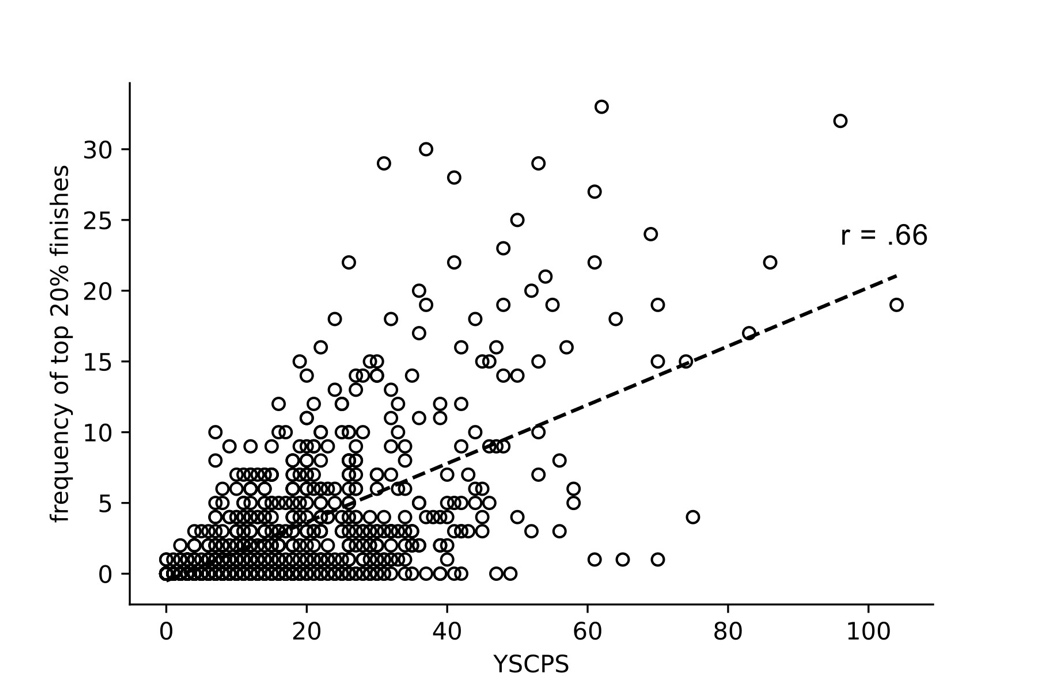
The robustness check included 1138 cyclists whose YSCPSs were related to their number of finishes among the first 20% of all race participants. The latter was taken as a measure of performance consistency to check if the YSCPS does not over-represent peak performance since it is based on the best two performances in each race type. The resulting Pearson r correlation coefficient was .66 (p<.001) (Figure fig. 1).

Retrospective analysis
Forty-eight cyclists were included in the logistic regression analysis. Two years after leaving the U19-category, 43 cyclists were classified as low-level and 5 cyclists as high-level. The model with the YSCPS as the independent variable correctly classified two cyclists more than the model based on the traditional ranking system (Table tbl. 7). The percentage of correctly classified cyclists was 87.5 for the traditional ranking system and 91.7 for the model based on the YSCPS.
Level predicted by logistic regression model | Total | |||
|---|---|---|---|---|
Low level | High level | |||
True level | Low level | 41 42 | 2 1 | 43 |
High level | 4 3 | 1 2 | 5 | |
Discussion
The aim of this paper was to provide a methodology to develop a measure of road cycling performance for all youth cyclists competing in the same age category while accounting for differences in the race levels and race types those cyclists compete in. The YSCPS can be a useful tool for talent identification and development since it can compare cycling performance both within and between cyclists. Until now, there has been no robust measure of cycling performance available to compare the performance between youth cyclists, while this seems important given the variability in the rates of performance development on the way to peak performance in adulthood. Because the YSCPS considers multiple race types that are relatively equally represented, it arguably gives a better overall view of cycling performance compared to traditional measures. This is reflected in the example calculations and our retrospective analysis. More specifically, the example calculations showed that the YSCPS prevents less common race types such as stage races or time trials from overshadowing race types that are more frequently on the calendar (e.g., criteriums). This prevents that practitioners may consider a cyclist to perform well while he or she is in fact good at only one discipline. Instead, it can be argued that youth cyclists need to be competent in multiple of the identified race types to succeed at the elite level. For example, for a cyclist who aims to become a specialist in the classic one-day races, it is required to perform well in (inter)national races of longer distances, but also to have the bike handling skills to position him- or herself in a peloton, which could be learned in criteriums or other cycling disciplines. Furthermore, in the retrospective analysis a slightly higher percentage of cyclists was classified correctly relative to their future cycling team level when using the YSCPS compared to a traditional ranking system. While the model based on YSCPSs still only correctly classified two out of five cyclists who reached a high-level, this is double as much as the traditional model and can therefore be seen as an important improvement given the low number of true talents. However, still three out of five high-level cyclists were incorrectly classified as low-level, emphasising the importance of a multidimensional approach to identify talent rather than solely relying on race results.
Including other cycling disciplines in the YSCPS is another of its strengths. According to the GSTM, a set of MPCs can be used for multiple task requirements (Elferink-Gemser & Visscher, 2012). Therefore, race results in other cycling disciplines can also be informative for road cycling performance. For example, Mathieu van der Poel, Wout van Aert and Marianne Vos belong to today’s best elite road cyclists and all have a background in cyclocross. Similar examples exist for mountain biking (e.g., Thomas Pidcock, Puck Pieterse) and track cycling (e.g., Filippo Ganna, Lotte Kopecky). Furthermore, we carefully chose to calculate the race type averages based on the best two performances within each race type with a minimum of three race participations. On the one hand, taking an average instead of the single best performance prevents that performance outliers would have much impact on the final score. On the other hand, limiting the number of races in the averaging process to only the best two performances decreases the probability that factors outside the cyclist’s own control (e.g., crashes, mechanical problems) impact the race type average. Our robustness check that related the YSCPS to the frequency of top 20%-finishes (as a measure of performance consistency) showed a moderate correlation (r = .66), suggesting that the YSCPS does not over-represent peak performance (Figure fig. 1). It is important to note that this correlation is not expected to be perfect, since the YSCPS is not intended to solely represent consistency. A measure focused solely on consistency would risk favouring cyclists who predominantly compete in lower-level races where achieving high placements may be more feasible. Finally, the YSCPS is calculated over an entire season, which allows to study the development of an individual cyclist over multiple years as well.
We developed the YSCPS for the Dutch competition structure in co-creation with three coaches of a national talent development programme. Given that these practitioners recognized the shortcomings of traditional ranking systems and agreed on how to correct for them, we consider the YSCPS as a measure with good content validity. And although the YSCPS could have been more robust if we included a larger group of experts, all experts we consulted were very experienced. However, a few points need to be taken in mind when using the YSCPS. First, there is no international race calendar for the U17-category, meaning that cyclists below this age cannot score points for the race type ‘international races’. Since these races are generally awarded with lower (i.e., more important) PSs, the YSCPS of U19-cyclists could be elevated compared to U17-cyclists, not necessarily because they perform better, but simply because they are now able to compete in more prestigious races. To better compare the YSCPS between these categories (for example, in longitudinal research), the YSCPS could be standardized using previously reported methods (Cesanelli, Lagoute, et al., 2024). However, for practical use of the YSCPS during a season it is recommended not to modify these scores to minimise deviations from what truly represents a cyclist’s performance compared to his or her peers. Second, it must be recognized that participating in another cycling discipline ‘just for fun’ could lower the YSCPS of a cyclist. Take for example two cyclists with identical YSCPSs based on road cycling disciplines. The one who in the winter recreationally participates in a cyclocross race might have a lower final YSCPS because the sum of his race type averages are divided by an additional race level. Finally, information on the criterion validity is still lacking, since there exists no golden standard for quantifying cycling performance. However, according to our retrospective analysis and youth cycling experts’ opinions, our approach better reflects youth cycling performance compared to traditional ranking systems.
The YSCPS is intended for talent coaches and researchers in the field of youth cycling. Talent coaches may well be aware of the shortcomings in traditional ranking systems and try to correct for this when identifying and monitoring cycling talent. The YSCPS can provide them a backbone for their decision making. The fact that the involved coaches from the talent development programme currently use the YSCPS in practice also shows its applicability in the field of talent identification and development. Researchers in turn could use the YSCPS to compare youth cyclists competing in the same category or to track youth cyclists in their development to an elite level. Further establishing how YSCPSs relate to future success indicators would provide insights into cycling talent development and add evidence to the usefulness of the YSCPS as a measure of youth cycling performance.
Conclusion
This paper provides a methodology to quantify youth road cycling performance that can be used to compare cyclists who have heterogenous performance levels and participate in different race types. Researchers and practitioners may adapt this methodology to the competition structure in their country to quantify cycling performance.