Abstract
A player’s kicking technique strongly influences penalty-kick outcomes, such as shot placement accuracy, yet it remains challenging to quantify holistically. Traditional analyses often focus on isolated biomechanical variables, which may not capture the integrated nature of whole-body movement or translate well into practical coaching. This study introduces an IMU-based principal component analysis (PCA) framework to quantify practice-oriented movement patterns in penalty kicks. The objectives were (1) to develop and validate interpretable “technique components” that represent practically executable movement strategies and (2) to apply them to examine how kicking technique varies practically with shot placement. Sixteen male amateur soccer players completed two tasks: (1) penalty kicks using deliberately exaggerated technique variations and (2) uninstructed self-selected kicks aimed at predefined goal zones. Whole-body kinematics (3D segment positions) were recorded with an Xsens IMU system. PCA was applied to time-normalized, mass-weighted segment positions centered to each participant’s baseline kick of the instructed technique extremes, yielding distinct and practically interpretable technique components. These represented continuous scales between opposing extreme strategies and were statistically validated using statistical parametric mapping (SPM). Valid components captured horizontal, vertical and lateral body movement, upper-body rotation, leg-swing strategy, sagittal and frontal arm swing, and head orientation. Subsequently, projecting the uninstructed kicks onto these components revealed systematic technique differences associated with shot placement (SPM rmANOVA). Shots to upper goal zones were characterized by a lower vertical body position and a stronger lateral lean toward the standing leg. By applying PCA to purposefully demonstrated technique variations, this study provides an objective framework for quantifying complex whole-body movement patterns in penalty kicks. The approach yields continuous, interpretable measures aligned with coaching terminology and can be applied to evaluate and monitor technique in practical settings. It offers a promising basis for data-driven feedback and future real-time training applications.
Keywords
football, kicking biomechanics, inertial measurement units IMUs, technique components, practical coaching
Introduction
Soccer matches are often decided by a small margin of goals, making goal-scoring opportunities, particularly set-piece situations, critical moments in the game (Dimov & Atanasov, 2022). Among these, the penalty kick stands out due to its structured nature and high scoring opportunity, often determining the outcome of matches, especially during shootouts (Buscà et al., 2022). For an outfield player achieving a successful outcome (i.e., scoring a goal) in a penalty kick requires the player to balance ball speed, placement accuracy, and potentially deception (Wood & Wilson, 2010). For a goalkeeper, visual cues about the opponent’s body segment postures and movements while taking the penalty kick may lead to anticipations and predictions of the ball trajectory (Diaz et al., 2012; Lees & Owens, 2011). For both actions, producing the kick and reading the kick, the actual complex, multi-segmental coordinated movement of the kicking person, often referred to as the “technique”, plays a fundamental role. While the outcome and performance metrics of a penalty kick (e.g., shot placement) are directly measurable, the actual technique—i.e., the whole-body coordination involving the interaction of the upper body, pelvis, standing and kicking leg (Lees et al., 2010), that links a player's movement to the specific outcome—is difficult to quantify.
Traditionally, biomechanical analysis of kicking technique has relied on quantifying isolated, discrete (i.e., single-point) variables, such as specific joint angles at key events (e.g., knee flexion/extension, hip rotation, arm abduction at support-leg touchdown or ball contact) (Aziz & Bylbyl, 2019; Buscà et al., 2022; Katis et al., 2013; Katis & Kellis, 2010; Lees & Owens, 2011; Prassas et al., 1990), often obtained using optical motion-capture systems in laboratory settings. While informative, this approach has several limitations. First, it provides only a limited view by focusing on isolated parameters that may not fully reflect the integrated, synergistic nature of whole-body movement (Federolf, 2016). Second, interpreting a large number of such discrete variables simultaneously can be complex, and translating them into practical coaching advice that athletes can intuitively convert into movement execution, is often difficult. Coaches typically observe and provide feedback on holistic movement patterns or “techniques” such as backward trunk lean, leg swing or arm swing strategies, rather than on specific joint-angle values (Lees, 2002). Third, laboratory-based optical systems can be restrictive and may not fully replicate the ecological conditions of on-field performance. Together, these factors create a significant gap between traditional biomechanical analysis and practical coaching applications.
Recent advancements in wearable sensor technology, particularly inertial measurement units (IMUs), offer a viable alternative for capturing kinematic data in less constrained, field-like environments (Blair et al., 2018; Debertin et al., 2024; Nijmeijer et al., 2023). IMUs provide data streams that, when processed through sensor fusion, describe the kinematic motion of multiple body segments simultaneously. However, similar to data from optical systems, analyzing this complex, high-dimensional data (i.e., data of a large number of different body segments over time) requires advanced computational methods (Zago et al., 2021).
Principal component analysis (PCA) is a powerful multivariate statistical tool used for dimensionality reduction and pattern recognition (Jolliffe & Cadima, 2016). In biomechanics, PCA can be applied to kinematic time-series across multiple variables, such as joint angles (Nakamura et al., 2018; Navandar et al., 2022) or visual feature histograms (Sato et al., 2015) of soccer kicking. While these multivariable approaches aim to provide a holistic representation of the complex coordinated movement behavior, their outputs often remain difficult to interpret in ways that align with practical implementation. Alternatively, PCA can be applied directly to 3D segment coordinate data to identify the dominant partial movements as coordinative multi-segment patterns according to the variance in the dataset (Daffertshofer et al., 2004; Federolf, 2016). Such coordinate-based PCA approaches have been used to analyze technique in sports (Federolf et al., 2014; Gløersen et al., 2018). As these PCAs were based on natural movement alone, which may not always encompass all possible technique variations, an optimized approach has been developed that performs PCA on practical, purposefully exaggerated technique executions (Debertin et al., 2022; Debertin, Haag, et al., 2024). By using such instructed, overemphasized variations to define the input variance, the PCA results are “anchored” to the practical movements associated with the technique variations.
To bridge the gap between traditional biomechanics, which provide data that is difficult to apply in practice, and practical coaching advice, which relies on holistic observations that lack objective quantification, this study proposes a novel framework for quantifying soccer kicking technique by combining ecologically valid IMU data with a specialized “variation-based” PCA approach.
The primary objectives of this study were:
To develop and validate a framework of quantifiable, interpretable “technique components” that represent practically executable movements within a penalty kick, based on PCA of whole-body kinematic data of deliberately exaggerated technique variations.
To apply this framework to quantify how these technique components change systematically in regular kicks based on shot placement into four different goal zones.
The rationale is to provide a foundational, objective framework for data-driven technique analysis, which can then be applied by coaches and athletes to either improve placement accuracy or enhance anticipation of the opponent. Crucially, this approach shifts the analytical focus from traditional single-joint variables to multi-segment coordination patterns derived from the covariance of all body segments. By quantifying these whole-body synergies, the framework aims to capture how a technique is executed as a coordinated system, rather than merely describing isolated postural events.
Methods
Participants
The study included 16 male amateur soccer players (mean age: 24.7 ± 3.3 years; mean height: 181.2 ± 4.7 cm; mean shoe size: 43.0 ± 1.1 EU) recruited from the student community of the University of Innsbruck. Participants were required to be actively affiliated with a soccer club and to have at least three years of playing experience. They were excluded if they had any injuries or conditions that might affect their ability to perform the kicking tasks or their normal technique. Participants completed a health-screening questionnaire to verify compliance with all inclusion and exclusion criteria. All participants provided written informed consent in accordance with the Declaration of Helsinki. The study protocol was approved by the responsible ethics review board of the University of Innsbruck (certificate 43/2024).
Experimental Setup and Protocol
The protocol consisted of two distinct data-collection parts, each corresponding to one of the study’s objectives. Part 1 was a “calibration” phase designed to generate the data (i.e., instructed, purposeful technique variations) needed to define interpretable technique components via PCA. This “artificial” dataset was not intended to represent real kicks, but was methodologically essential to “force” the PCA to isolate and define quantifiable components that correspond directly to practice-oriented movement patterns (e.g., a “horizontal movement” component that captures the continuous spectrum between backward and forward lean). Part 2 was then designed to apply these components to uninstructed kicks aimed at specific target zones in order to analyze the self-selected techniques used under realistic kicking conditions. All data recording took place outdoors at the sports campus of the University of Innsbruck on natural grass turf. A goal (height: 2.44m; width: 7.32m) and penalty spot (11 meters from the midpoint of the goal line) were used according to the standard regulations of the Fédération Internationale de Football Association (FIFA). Standard FIFA-approved footballs (size 5) were employed. Participants performed a series of simulated penalty inside-kicks with their preferred kicking leg and a standardized three-step approach at approximately a 45° angle. These constraints (kick type and approach) were kept constant across all trials and participants to ensure a standardized basis for comparing whole-body technique variations during the kick. While these kicks were performed in a controlled setting without a goalkeeper or match pressure, they are referred to as “penalty kicks” for consistency with the 11-meter distance and task.
For Part 1, after an individual warm-up, each participant performed 20 penalty kicks. No specific target areas were given in this phase; participants first performed two baseline kicks with their natural technique (i.e., their normal, self-selected kicking motion without any specific technical instruction), followed by 18 kicks using predefined technique variations. The baseline was not externally validated; rather, it was recorded to serve as an individual-specific reference for data centering in the subsequent analysis. The technique variations were intended to represent movement patterns usually described and analyzed in practice. The order of these trials was randomized. Each variation was demonstrated in two opposing, deliberately exaggerated executions (e.g., forward vs. backward lean), creating nine contrasting pairs of two extremes, each associated with a specific technique principle (Table tbl. 1).
Technique variation | Technique principle | |
|---|---|---|
PCA1 | Forward lean of the upper body Backward lean of the upper body | Horizontal movement |
PCA2 | Low hips ('sitting position') Upright hips | Vertical movement |
PCA3 | Strong lateral lean of the upper body toward the standing leg side No lateral lean of the upper body toward the standing leg side | Lateral movement |
PCA4 | Rotation of the upper body to the player’s left Rotation of the upper body to the player’s right | Upper body rotation |
PCA5 | Large leg swing range of the kicking leg in posterior and anterior direction Small leg swing range of the kicking leg in posterior and anterior direction | Leg swing |
PCA6 | The position of the standing leg in front of the ball The position of the standing leg behind the ball | Standing leg position |
PCA7 | Large arm swing range of the arm on the kicking leg side in the sagittal plane from posterior to anterior direction (i.e., the arm swinging parallel to the shooting direction, moving from back to front) Small arm swing range of the arm on the kicking leg side in the sagittal plane | Sagittal arm swing |
PCA8 | Large arm swing range of the arm on the standing leg side in the frontal plane from lateral to medial direction (i.e., swinging across the body perpendicular to the shooting direction) Small arm swing range of the arm on the standing leg side in the frontal plane | Frontal arm swing |
PCA9 | Head facing upward Head facing downward | Head orientation |
Eighteen technique instructions (one trial recorded per instruction) were grouped into nine contrasting pairs of opposing extremes, and a separate principal component analysis (PCA) was performed for each variation pair, resulting in one principal component (PC) representing the underlying technique principle.
Participant compliance with these instructions was not verified during collection, but was validated post-hoc in the statistical analysis to confirm that the contrasting instructions produced significantly different movement patterns.
For Part 2, the participants performed new 20 penalty kicks. This time they were asked to score into four designated target zones (lower right, lower left, upper right, upper left), while no technique instructions were given. Five penalty kicks were recorded per target zone. Shot placement was determined from video footage by identifying the ball impact location and assigning it to one of the defined target zones (Figure fig. 1). Only trials in which the ball successfully hit a target zone were included in the analysis.

Instrumentation and Data Acquisition
Whole-body kinematics were recorded using the Xsens MVN Link system (Movella Inc., Enschede, The Netherlands). Seventeen IMUs were placed within a tight-fitting suit according to manufacturer placement guidelines (i.e., on the feet, shanks, thighs, pelvis, sternum, head, shoulders, upper arms, forearms, hands). The IMUs include gyroscopes, accelerometers, and magnetometers, sampling at 240 Hz. A sensor calibration procedure (N-pose followed by walking) was performed for each participant before data collection, following the manufacturer's standard protocol, to align sensor axes with body segments.
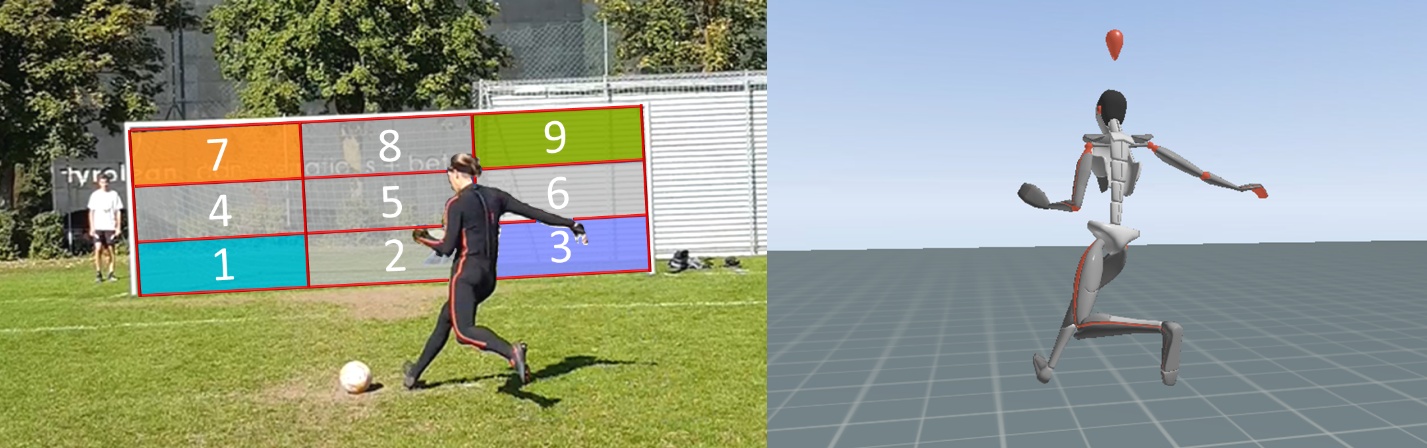
Seventeen IMUs were placed within a tight-fitting suit, and segment coordinates were extracted in a local reference frame. In the second part of the study, kicks aimed at different goal zones were recorded. For this purpose, the goal was divided into nine equal sections. Only successful hits in the four corner zones (lower right: zone 3; lower left: zone 1; upper right: zone 9; upper left: zone 7) were analyzed with regard to the used techniques.
Data Analysis
The analysis pipeline (Figure Cross reference to deleted element image2.png) involved (I) preprocessing the kinematic data including centering it relative to each participant’s baseline kick; (II) a specialized PCA procedure, consisting of nine separate variation-specific PCAs, to establish “technique components” from the instructed exaggerated movements in Part 1 and projecting the shot placement trials of Part 2 onto these components; and (III) statistical parametric mapping (SPM) analyses (Pataky et al., 2013) to first validate the components and then test their relationship with shot placement in the uninstructed kicks of Part 2. IMU data were initially processed using Xsens MVN Analyze (Version 2020.2) to obtain 3D positions of 23 body segments in a pelvis-centered local coordinate system over time (Figure fig. 1, right panel). Further data processing was performed through custom-written MATLAB code (Version R2022b, The MathWorks, Natick, Massachusetts, USA). The following steps were implemented for each trial:
To ensure comparability, segment positions were mirrored in y-direction of the local coordinate system (medial-lateral) for all left-footed kicks. Shot placements were mirrored as well, so that “left” and “right” goal zones refer to the contralateral and ipsilateral side of the kicking leg, respectively.
To isolate the kicking motion itself, the recorded movement was temporally segmented relative to the ball contact time point (calculated based on the peak acceleration across all three axes of the respective kicking foot sensor data), from the posterior-most position of the kicking foot (minimum x-coordinate in the local coordinate system) to its anterior-most position (maximum x-coordinate). This segmentation aligns with the tension arc release phase as defined by Shan et al. (2019).
The segmented movement was time-normalized to 100% using interpolation.
Time-normalized data from each participant’s two individual baseline kicks (i.e., the kicks without specific instructions from the first part) were averaged and subtracted from each trial at every time step. This step was crucial as it centered the data, ensuring that the subsequent PCA would only analyze the deviations (i.e., the specific technique variations) from each participant's baseline.
Centered whole-sequence data were weighted according to the mass distribution across body segments (de Leva, 1996) and further normalized using the mean Euclidean distance to account for different body sizes (Federolf, 2016).
These preprocessing steps resulted in a uniformly right-footed, kick-segmented, time-normalized, baseline-centered, mass-weighted, and body-size-normalized data matrix of 101 timesteps × 69 segment coordinates (x-, y-, z-coordinates of 23 segments) for each trial.
Subsequently, a total of nine separate “variation-specific” PCAs were calculated from the instructed technique trials in Part 1 (Table tbl. 1). Thereby, each PCA was run on a specific subset of this data, e.g., to create the “horizontal movement” component, the input matrix for the PCA was constructed solely from the trial data matrices of “forward lean” and “backward lean”, concatenated across all participants. This process was repeated for each of the nine opposing technique pairs (e.g., “low hips” vs. “upright hips”; “large leg swing” vs. “small leg swing”). For each of the nine PCAs, the resulting principal components (PCs) were inspected visually. Because the instructed executions intentionally introduced variability between two contrasting extremes, one PC within each PCA was expected to represent the primary axis of variance between the input extremes. The component that best captured this variance was identified by visually inspecting the projection of the original input movements onto the PCs (the “principal movements”, PMs) using stick-figure animations (Federolf, 2016). For example, in the “forward/backward lean” PCA, the PC whose PM animation most clearly and dominantly depicted a forward and backward leaning motion of the torso was selected. This selected PC was then designated as the quantifiable “technique component” for “horizontal movement” variations. The technique component not only separates the two extremes but also places the underlying technique principle on a measurable, continuous scale between those extremes (e.g., a scale from “forward lean” to “backward lean”), thereby ensuring practical interpretability (Debertin et al., 2022; Debertin, Haag, et al., 2024).
The nine extracted technique components then serve as the basis for the technique analysis framework. They can be applied to any kicking motion to quantify how, and to what extent, the specific technique was executed. This application involves projecting a kicking trial onto a respective technique component. By multiplying the new trial’s data matrix with a PC, time-series PC scores (termed “principal positions”, PPs) are calculated. PMs are then reconstructed by multiplying a PP with the transposed PC (Figure Cross reference to deleted element image2.png). Each PP value is therefore directly linked to a distinct body posture representing the associated movement in the original three-dimensional space (PM). PPs can be visualized as waveforms, and PMs as animated stick figures over time. For PM visualization, the origin of the local coordinate system was shifted vertically downward to the ground, which was defined as the absolute lowest foot position within the segmented trial.
To validate the framework, the extreme technique trials from Part 1 were projected onto their corresponding components they have generated. Validation required that the PP waveforms of the two opposing technique extremes were statistically separable.
Following validation, the technique components were applied to the data from Part 2 by projecting the uninstructed kicks onto them, allowing for an analysis of which technique variations players used when aiming for specific goal zones. As an example, the main technique components of horizontal, vertical, and lateral movement variations were used, generating three distinct time-series PPs for each shot. Only successful shots into four goal zones (lower right, lower left, upper right, upper left) were included in the statistical analysis.
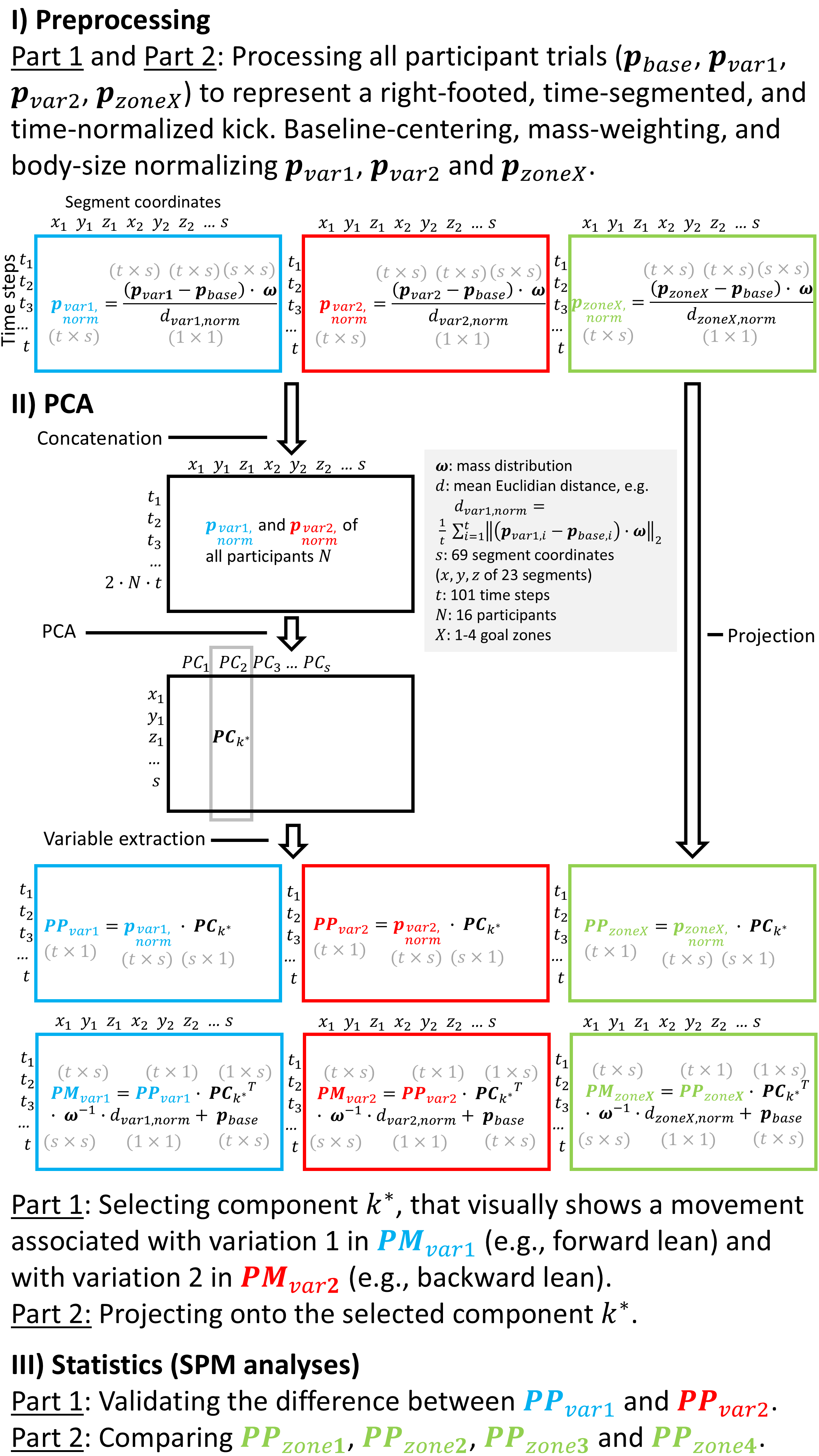
The same procedure was repeated for all nine variation pairs (Table tbl. 1). Segment position data obtained from the Xsens system were pre-processed (right-foot mirroring, temporal segmentation, and time normalization) for the baseline trials (pbase), contrasting variation trials (pvar1 and pvar2) and the goal-zone-targeted trials (pzoneX). Each trial matrix p contains the segment data over time (t × s). The pre-processed data was baseline-centered, weighted by segment mass distribution (de Leva, 1996), and normalized by the mean Euclidean distance (Federolf, 2016). For Part 1, normalized trials of the two instructed variations (e.g., forward vs. backward lean) were concatenated across participants to form the PCA input matrix. One principal component (PC) was selected based on visual inspection of the corresponding principal movements (PMs) using stick-figure animations and subsequently validated using SPM analyses of the associated principal positions (PPs). For Part 2, normalized trials targeting four goal zones (lower right, lower left, upper right, upper left) were projected onto the selected PC, and the resulting PPs were statistically compared using SPM.
Statistics
Technique components derived from Part 1 were validated for plausibility using SPM (Pataky et al., 2013). Specifically, an SPM paired-samples t-test compared the time-series PPs between two contrasting instructed variations (e.g., “forward lean” trials vs. “backward lean” trials) at α = 0.05, when projected onto the component that was selected as a representation for the corresponding underlying technique principle (e.g. “horizontal movement” component). Plausibility was defined a priori as significant differences in the PP waveforms occurring over more than 25.0% of the time-normalized kicking motion.
For Part 2, to evaluate the relationship between technique and shot placement, the kinematic data from the successful shots were projected onto the technique components for horizontal, vertical and lateral movements (i.e., the respective PCs established in Part 1). Subsequently, an SPM rmANOVA was used to compare the resulting PP waveforms between the four target zones (lower right, lower left, upper right, upper left), treating the target zone as the within-subject factor. Bonferroni post-hoc tests were used where appropriate (Pataky et al., 2015). This allowed for the determination, for example, if the “vertical movement” PP waveform was significantly different for shots aimed at upper zones versus lower zones.
Results
Technique Components Determined in Part 1
Horizontal movement: Figure fig. 3a displays the PP waveforms for the instructed forward and backward upper body lean on the PC representing horizontal movement deviations relative to the baseline kick. The baseline kick has a PC score of zero since the body position of the baseline movement execution was subtracted from each trial per time step. SPM confirmed a significant difference between forward and backward lean throughout the entire kicking motion (p < .001 between 0.0% and 100.0%). The maximum difference occurred at the end of the analyzed sequence. The body configurations associated with the PPs at this time step of maximal difference are shown as stick figures (Figure fig. 3a).

Vertical movement: The instructed vertical positioning (low vs. upright hips), also led to changes in posture that could be captured with the proposed PCA approach (Figure fig. 3b) and PPs differed significantly between the instructions throughout the whole analyzed sequence (SPM: p < .001; 0.0%–100.0%). The upright hip position remained closer to the baseline technique across the movement, whereas the low hip position deviated increasingly toward the end of the kicking motion.
Lateral movement: A technique component representing lateral upper-body lean was identified from the PCA contrasting strong vs. minimal lateral lean (Figure fig. 3c). The two variations differed significantly (SPM: p < .001; 0.0%–100.0%) within this technique component. No lateral lean, i.e., a more centered position, was closer to the baseline technique.
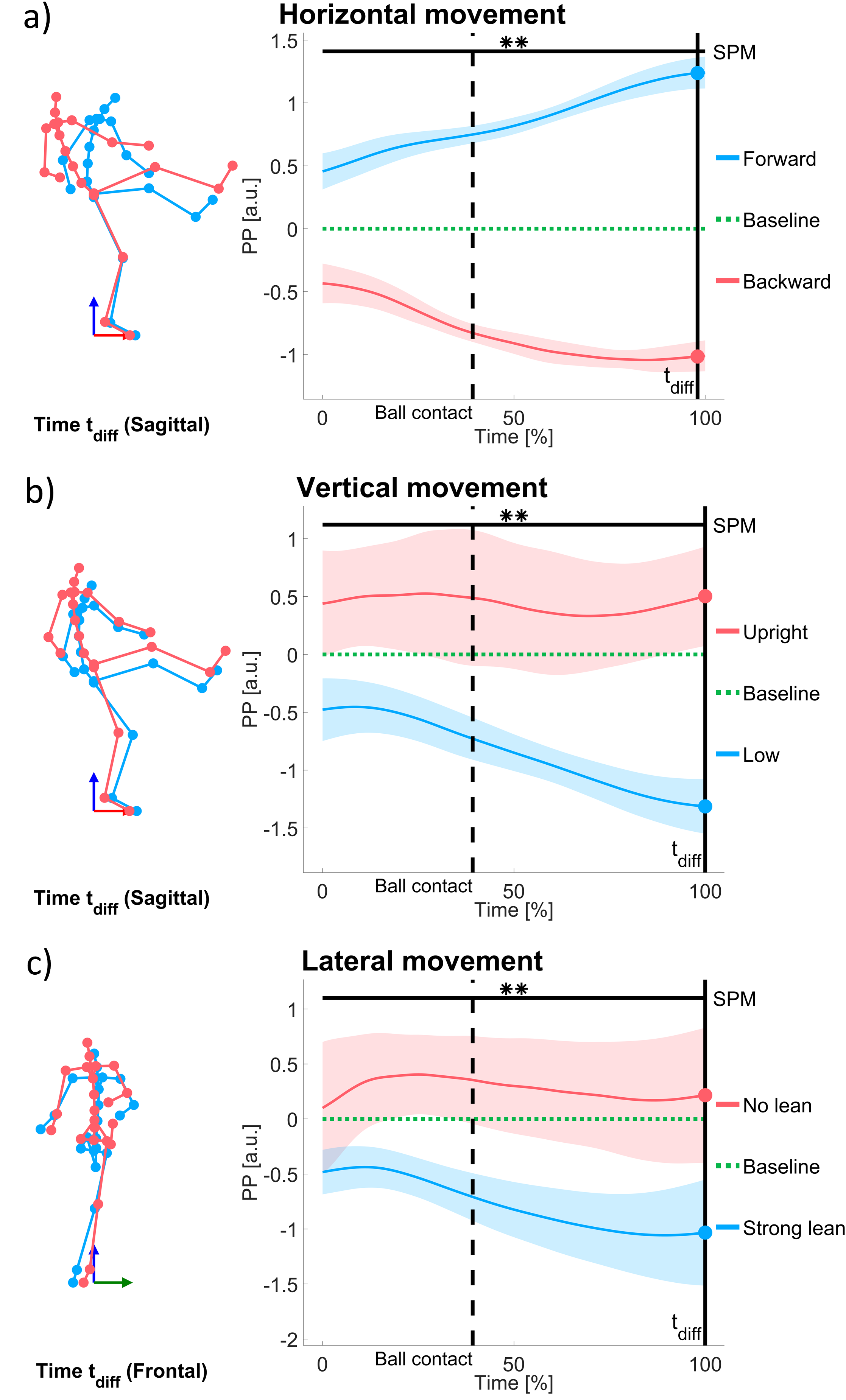
Each component is derived from a PCA that included two contrary extreme technique executions (a: forward vs. backward lean; b: low vs. upright hips; c: strong vs. no lateral lean to the standing leg side), performed by experienced soccer players (N = 16). On the right of each panel, mean (bold line) and standard deviation (shaded area) of the time-evolution of the PC score (termed principal position, PP) of these two extremes along the respective technique component are plotted (red and blue). PPs represent deviations from the mean baseline kick without any technique instructions (zero deviation shown as dotted green line). On the left of each panel, body postures associated with the PP value at the time point of maximal difference (tdiff) are shown. Statistical parametric mapping (SPM)-based significant differences between the PP waveforms are indicated by horizontal lines over the corresponding time periods (**: p < .001; *: p < .05).
Upper body rotation: The instructed rotation to the left versus right from the player's perspective was captured by a PC in the corresponding PCA (Figure fig. 4a). A significant difference between the different rotation strategies was observed in the initial phase before ball contact (SPM: p = .01; 0.0%–48.0%) and in the final phase of the kicking motion (SPM: p = .021; 64.6%–100.0%), with higher scores for a rotation to the left and lower scores for a rotation to the right. All trial data were processed to represent a right-footed kick. An upper body rotation to the left was closer to the baseline technique.

Leg swing: A technique component for leg swing distinguished between large and small swing ranges of the kicking leg, with significant differences occurring in both the initial (SPM: p = .037; 1.8%–17.1%) and final phase of the movement (SPM: p < .001; 36.7%–100.0%), covering 78.6% of the kicking motion (Figure fig. 4b). The maximum difference occurred at 100.0%, while the mean waveforms showed a mirrored shape for the whole time.
Standing leg position: A technique component for the standing leg position (instructed foot placement ahead vs. behind the ball) was identified based on the PM visualization, with significant differences from 18.7% to 100.0% (p < .001) of the analyzed motion sequence (Figure fig. 4c).
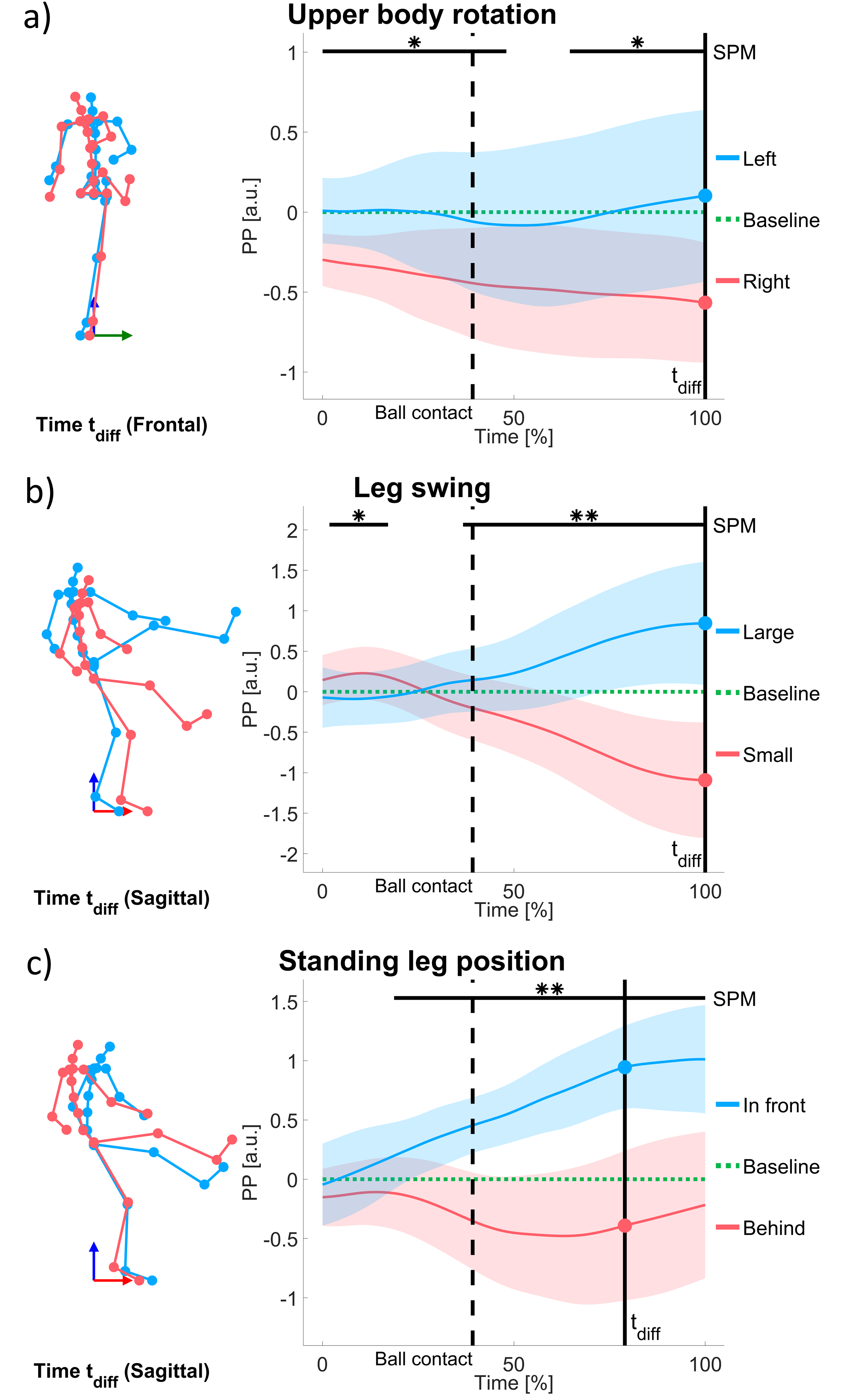
Each component is derived from a PCA that included two contrary extreme technique executions (a: rotation to the player's left vs. to the right; b: large vs. small range of the kicking leg swing; c: position of the standing leg in front vs. behind the ball). Conventions for illustrations, format, and labeling are analogous to those in Figure fig. 3.
Sagittal arm swing: The magnitude of the sagittal arm swing (instructed small vs. large arm swing range parallel to shooting direction of the arm on the kicking-leg side, i.e., the right arm after data processing) was represented by a component within the respective PCA (Figure fig. 5a). The small and large sagittal arm swing conditions differed significantly before ball contact (SPM: p = .007; 0.0%–30.6%), with the small arm swing range being closer to the baseline technique.

Frontal arm swing: The PCA of crossed arm swing instructions of the arm on the standing-leg side (i.e., the left arm after data processing) yielded a component representing frontal-plane arm swing (Figure fig. 5b). A significant difference (SPM: p = .032; 8.2%–24.9% and p = .001; 52.0%–100.0%) was found before and after ball contact. The two mean PP waveforms showed a mirrored shape.
Head orientation: One PC within the PCA using instructed trials of head facing upward vs. downward captured head orientation (Figure fig. 5c). The two variations differed significantly (SPM: p < .001; 0.0%–100.0%) throughout the entire kicking motion, deviating in opposite directions from the baseline technique.
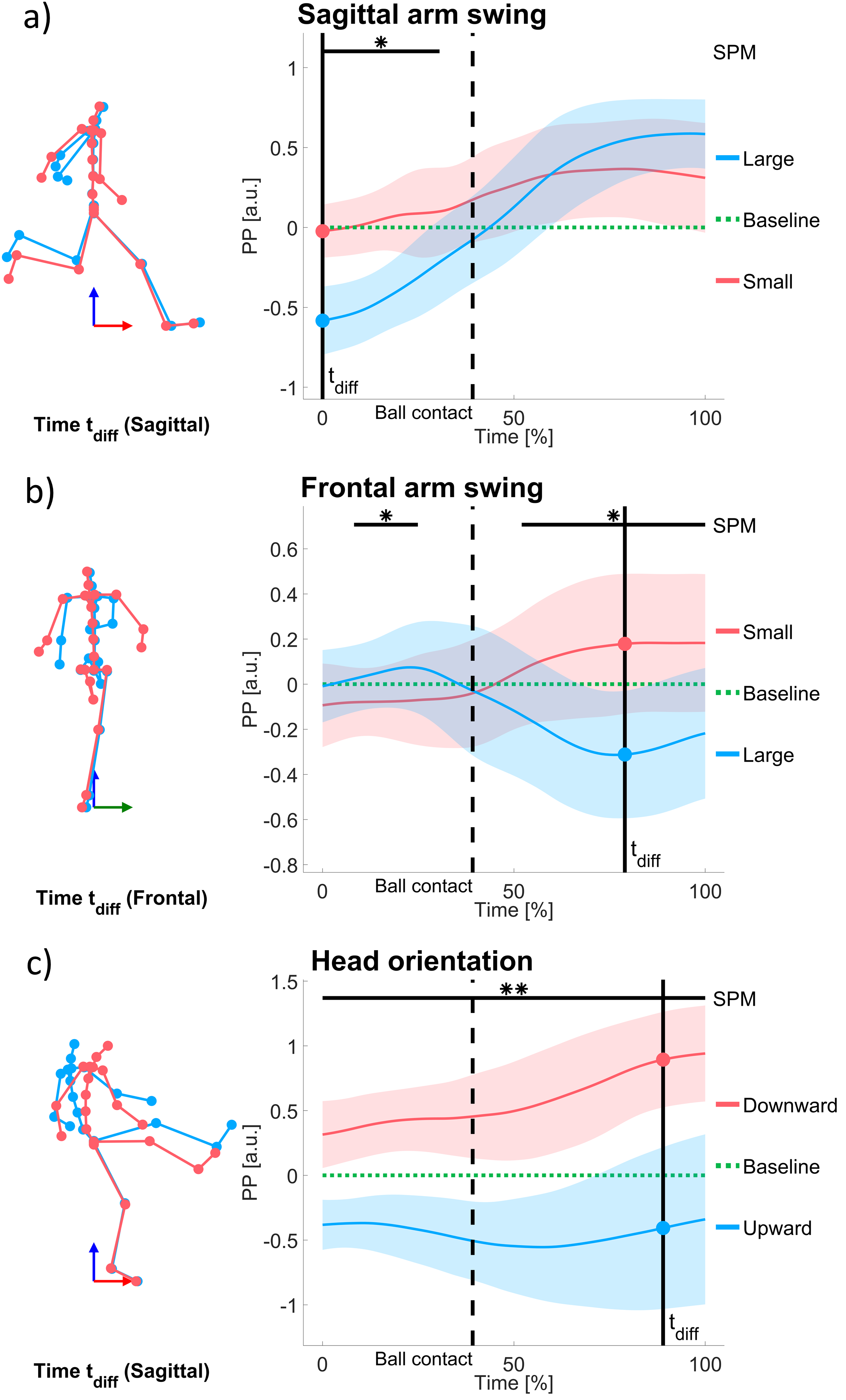
Each component is derived from a PCA that included two contrary extreme technique executions (a: large vs. small sagittal arm swing in shooting direction of the arm on the kicking leg side; b: large vs. small frontal arm swing perpendicular to shooting direction of the arm on the standing leg side; c: the head facing upward vs. downward). Conventions for illustrations, format, and labeling are analogous to those in Figure fig. 3.
Relationship Between Technique Components and Shot Placement Investigated in Part 2
Projection of the shot-placement trials onto the “horizontal movement” technique component revealed no significant differences between goal zones at any time phase (Figure fig. 6a).

Vertical movement PPs differed significantly between shot placements until ball contact (Figure fig. 6b; SPM: p = .018; 0.0%–30.1%). Post-hoc tests revealed significant differences between lower right and upper left zones (SPM post-hoc: p = .004; 0.0%–26.9%). Overall, kicks to the upper zones showed more negative scores on the vertical movement component, corresponding to a lower hip position (as shown in Figure fig. 3b) compared to kicks to lower zones, particularly in the initial portion of the movement.
Lateral movement PPs differed significantly between shots into different zones in the initial phase of the movement, occurring from 0.3% until 39.5% of the normalized kicking motion (Figure fig. 6c; SPM: p = .005). Post-hoc tests showed significant differences between lower right and upper left zones (SPM post-hoc: p < .001; 2.8%–41.5%), indicating that shots to upper goal zones were characterized by a greater initial lateral upper-body lean.
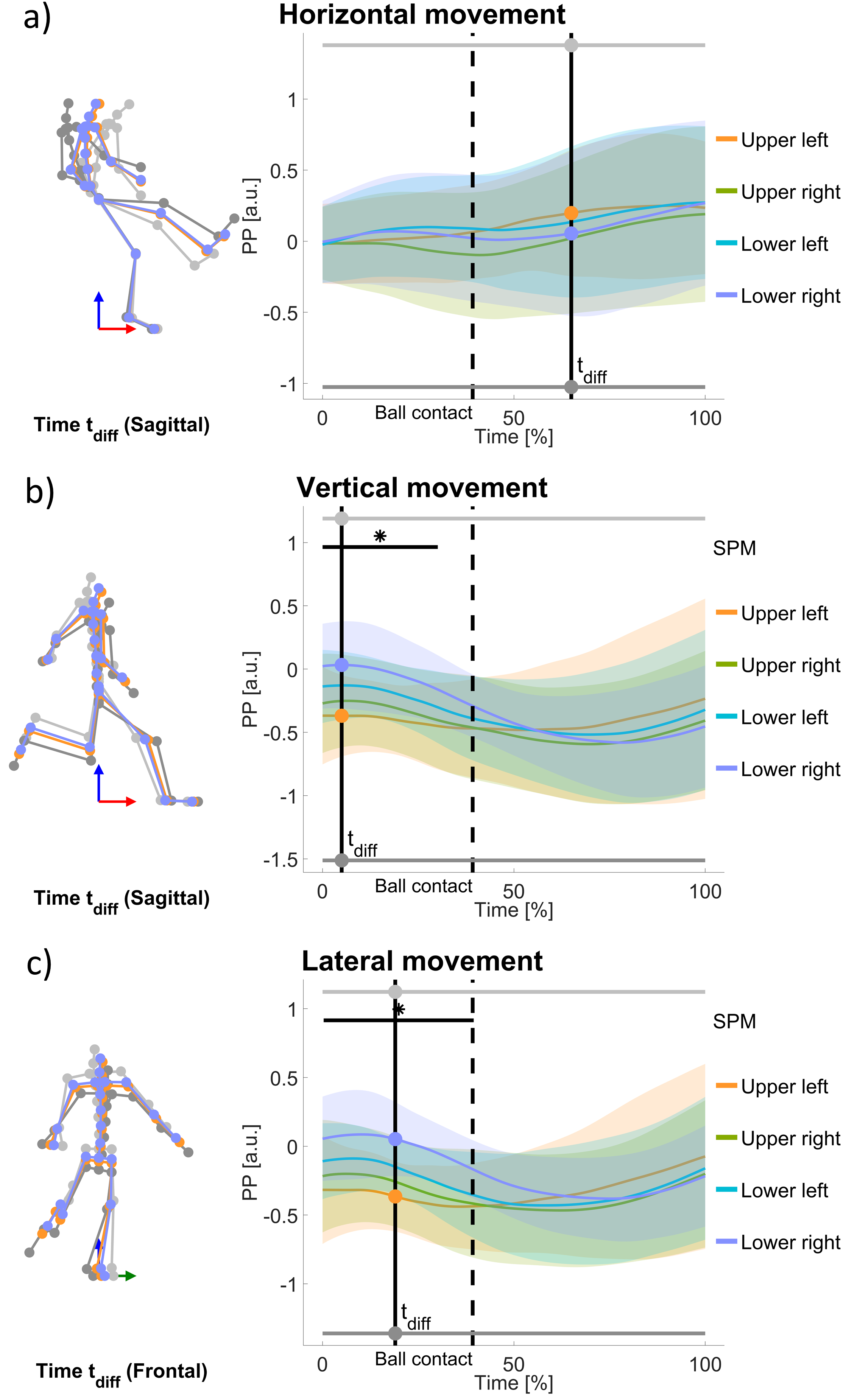
On the right of each panel, mean (bold line) and standard deviation (shaded area) illustrate the time-evolution of the PC score (termed principal position, PP) for successful hits into four different goal zones (lower right, lower left, upper right, upper left) after projection onto the respective technique component. Results of a statistical parametric mapping (SPM)-based rmANOVA between the PP waveforms of the four zones are indicated by horizontal lines over the corresponding time periods (**: p < .001; *: p < .05). On the left of each panel, body postures are shown for the time point of maximal PP difference (tdiff) occurring between lower right and upper left zone. Grey and dark grey scores are illustrative and shown for reference only.
Discussion
Calibration of Technique Components to Quantify Kicking Technique
This study’s first aim was to develop and validate a framework for quantifying soccer kicking technique as described in practice, using PCA applied to whole-body IMU data from instructed, deliberately exaggerated technique variations (Part 1). This approach, previously utilized in other sports (Debertin et al., 2022; Debertin, Haag, et al., 2024), has now been successfully adopted for soccer kicking technique. It provided meaningful, sport-specific technique measures that enable the quantification and direct interpretation of practice-oriented techniques, thereby bridging the gap between subjective, holistic coaching advice and objective biomechanical data.
The findings confirm that a set of valid and interpretable “technique components” can be defined for horizontal, vertical, lateral movements, upper body rotation, leg swing, standing leg positioning, sagittal and frontal arm swing, and head orientation during a kick. PCA analyzes the variance in the dataset. As variance was actively induced through instructed extremes, it is expected that a resulting PC directly reflects the variation between two opposing extremes. This was intended and confirmed by statistically analyzing the input extremes along the component they generated. Consequently, the resulting PPs differed significantly according to the SPM results, fulfilling the plausibility criterion of differences across more than 25.0% of the kicking motion for all listed components. While these extremes are not typically executed in practice, this validation confirms that the components accurately reflect the intended movement variations, allowing any kick to be analyzed on the continuous scale between these bounds.
Application of Technique Components to Analyze Relationship of Technique to Shot Placement
The second aim was to apply this validated framework to quantify and analyze the technique of self-selected, uninstructed kicks in relation to shot placement (Part 2). Differences in technique were observable between shots placed in different goal zones, demonstrating the applicability of the defined technique components.
Previous literature suggests that players lean backward to achieve a higher ball trajectory (Prassas et al., 1990). However, the present findings indicate that horizontal upper-body posture did not meaningfully influence shot height within successful scoring attempts (Figure fig. 6a); that is, no significant backward lean is required to score in an upper zone. This relationship may differ in unsuccessful attempts where the ball overshoots the goal. These trials were not included in this study but could be explored in future work using the provided technique component for “horizontal movement”. Additionally, backward lean can reduce ball velocity by shortening the effective lever arm of the kicking leg (Orloff et al., 2008). Because higher ball speed is strongly linked to scoring success—by reducing goalkeeper reaction time and increasing goal danger (Hunter et al., 2018; Rađa et al., 2019)—maintaining a consistent horizontal posture may represent a strategy to optimize both trajectory control and ball speed. A likely factor differentiating shots into upper versus lower zones is the precise ball contact point, which the whole-body PCA was not designed to isolate. It is a well-established biomechanical principle that striking the ball lower on the foot produces a higher trajectory (Prassas et al., 1990). It is plausible that players in this study relied primarily on this contact point adjustment rather than significant changes in whole-body horizontal posture to control vertical shot placement. However, other whole-body variations may contribute to achieving such a lower contact point and thereby scoring into an upper goal zone.
Vertical movement, for example, did show significant differences between shots targeting different height zones, particularly in the early phase of the kicking motion (Figure fig. 6b). Shots to upper zones involved greater downward hip movement, which likely produces a lower contact point and consequently a higher ball trajectory (Prassas et al., 1990). This coordination, captured by the vertical movement component, appears to be a whole-body mechanism for achieving the desired contact point.
Similarly, lateral movement differed significantly between shot placements (Figure fig. 6c). Shots aimed at upper zones involved greater lateral movement toward the standing leg. This can be achieved through increased inclination of the stance leg (Petrone et al., 2006), which increases ball speed (Kapidžić et al., 2014), which is beneficial for upper targets (Lees et al., 2010; Ou et al., 2023). Lateral lean with leg inclination may also represent a key biomechanical strategy for optimizing the ball contact point. By shifting the center of mass laterally, the player can better position the kicking foot to strike the ball lower—a key requirement for a higher ball trajectory (Prassas et al., 1990). Future studies should combine whole-body technique measures with ball contact point detection and ball speed analysis to further clarify these mechanisms.
Limitations
This study has several limitations. The sample consisted exclusively of male amateur players; findings might differ in other populations and particularly in elite athletes, who may exhibit motor equivalence—using different movement combinations to achieve the same goal, often for deception. Furthermore, while the data were normalized to account for different body sizes, the influence of anthropometric differences (e.g., height, leg length) on the choice of technique was not explicitly investigated. Although IMU-based positional estimates may be susceptible to drift, this limitation is less impactful in short-duration movements such as penalty kicks. However, sensor slippage during abrupt movements may still affect data quality. Next, SPM-based post-hoc comparisons may introduce statistical uncertainty due to separate smoothness estimates across comparisons (Pataky et al., 2013). While errors are expected to be small, this inherent uncertainty necessitates cautious interpretation of the post-hoc results. Moreover, the analysis did not measure discrete performance variables such as ball contact point or ball speed, which are essential for a complete biomechanical interpretation. This approach is not positioned as superior to traditional analyses; rather, it is presented as a complementary tool that may help connect detailed biomechanical findings with more intuitive, practice-oriented feedback. Finally, the controlled experiment lacked match-like psychological pressure, which may influence shooting behavior (Wood & Wilson, 2010).
Practical Implications and Future Research
The findings suggest that the derived PCs can serve as objective tools for coaches to assess penalty kick technique relative to a desired shot outcome. Rather than defining technique as “good” or “bad”, this approach allows specific technique components (e.g., vertical movement) to be quantified and compared to the profiles associated with different shot placements. For example, if higher shots are associated with more negative PP values in the vertical movement component, coaches can use a player’s individual PP waveform to identify whether adjustments in this aspect of technique may support the intended outcome. Conversely, the findings could be invaluable for goalkeeper training. Understanding which movement patterns (like vertical hip movement or lateral lean that precede ball contact) are associated with specific shot placements could help goalkeepers better anticipate the kick's trajectory. In this way, the method provides a structured link between quantified movement patterns and practical technique training. The framework is intended to augment a coach's expertise with objective data, not replace it.
Future research should aim to validate the usefulness of the technique components for coaches and athletes in practical settings, as well as in longitudinal intervention studies that track individual technique development in relation to shot placement. Additionally, transferability to elite players and the influence of factors such as fatigue, psychological pressure, and different kicking instructions (e.g., power vs. placement, with or without deception) should be examined.
Conclusions
This study successfully quantified technique variations in penalty kicks among amateur players using PCA applied to IMU-based whole-body kinematic data. The approach yielded distinct and interpretable movement components representing different technical strategies. Specific components varied systematically with shot placement, demonstrating their functional relevance. This methodology offers a powerful approach for moving beyond traditional, discrete biomechanical variables towards a more holistic and practically applicable understanding of complex sports movements. The combination of wearable IMU technology and PCA holds considerable promise for developing data-driven tools to support player assessment and technique training in soccer.