Abstract
To use the potential of non-profit sport organisations to drive climate action, policies targeting sport club members are relevant. However, successful implementation depends on members’ willingness to support. This study examined whether there are different clusters of Swiss Alpine Club members in terms of their willingness to support clubs’ climate policies through financial contributions, voluntary work and climate-friendly behaviour. An online survey of 1,881 members found that 65.5% of respondents were willing to pay an average of 23.72 CHF annually, 65.9% were willing to volunteer an average of 3.07 half-days per year and 52.2% exhibited a willingness to show climate-friendly behaviour to support clubs’ climate policies. Cluster analysis identified four distinct clusters of members regarding their willingness: those particularly willing to volunteer, those particularly willing to pay, those particularly willing to behave in a climate-friendly fashion and those who were below-average supporters of climate policies. The clusters differed regarding club identification and subjective club norms but not regarding current voluntary work or subjective social status. The findings highlight the need to allow members to contribute in various ways (e.g. offering optional climate fees, volunteer opportunities and behavioural incentives) to foster widespread climate policy implementation in organised sport.
Keywords
non-profit sport organisations, climate action, environmental sustainability, pro-environmental behaviour, cluster analysis
Introduction
Non-profit sport organisations have the potential to make remarkable contributions to climate action in and through sport. Especially in Europe, they are the most important sport providers, with 60 million active sport club members (Breuer et al., 2015). Climate policies in non-profit sport organisations can potentially reach many sport activities and participants, thus driving change.
Climate policies in sport organisations have primarily been studied in the International Olympic Committee (e.g. Cantelon & Letters, 2000; Geeraert & Gauthier, 2017; Weiler & Mohan, 2010), collegiate athletic departments (e.g. Casper et al., 2012) and professional sport organisations (e.g. Babiak & Trendafilova, 2011; Cury et al., 2022; Todaro et al., 2023; Trendafilova et al., 2013). Studies have revealed these organisations have a rather low-level commitment to climate action (e.g. McCullough et al., 2020; Wall-Tweedie & Nguyen, 2018). In recent years, it has also become evident that non-profit sport organisations are engaging in climate action at a relatively low level, insufficient to drive transitions to climate-friendly operations (e.g. Cury et al., 2023; Hugaerts et al., 2022; Moon et al., 2022; Sandvik & Seippel, 2022). To harness the potential of non-profit sport organisations for climate action and to initiate widespread change, comprehensive policies are needed that also target grassroots sport activities and club members. Due to the dependence of federations and clubs on their members and members’ autonomy (Thiel & Mayer, 2009), the effective implementation of climate policies depends on member support. Therefore, it is crucial to understand the willingness of members to support climate policies of their sport club or federation. Considering various forms of willingness and the diversity of members, this study identifies clusters of members regarding their willingness to pay (WTP), volunteer (WTV) and behave climate-friendly (WTB) to support climate policies.
Literature Review
Willingness to Pay
Previous research on willingness of sport participants to support climate policies has primarily examined WTP. This concept is rooted in behavioural economics and describes the maximum amount individuals are willing to pay for a particular (including non-market) good or service (Walker & Mondello, 2007). Sport event participants’ WTP for environmentally sustainable sport apparel, events and initiatives has been analysed (Könecke et al., 2021; Lintumäki et al., 2023; Spindler et al., 2023; Triantafyllidis & Kaplanidou, 2021). Further studies consider fans’ WTP for environmentally sustainable merchandise clothing, and environmental initiatives of professional sport organisations (Greenhalgh & Drayer, 2020; Scharfenkamp & Wicker, 2024). Sport club members’ WTP has been evaluated for membership fees (Swierzy et al., 2018; Wicker, 2011), overall club quality improvement (Kiefer, 2015) and coaching (Orlowski & Wicker, 2016). In WTP for climate policies, Thormann and Wicker (2021) reported that 64% of team and racket sport club members reported a positive WTP for club environmental measures (M = 23 Euros). WTP was positively correlated with environmental consciousness, educational level, weekly practice, identification and satisfaction with the club, and subjective well-being, while age showed a U-shaped effect. The amount of WTP correlated with environmental consciousness, educational level and satisfaction with the club (Thormann & Wicker, 2021).
These WTP studies suggest that introducing a climate action contribution in the membership fee could support implementation of climate policies in non-profit sport organisations. However, the figures also indicate that not all members are willing to support such policies financially. It is possible that some wish to contribute to climate action in and through organised sport but prefer – or are only able – to do so in non-monetary ways. Given that sport clubs are largely defined by their voluntary nature (Thiel & Mayer, 2009), climate policies, especially in sport clubs, could also be supported through members’ voluntary work (e.g. committee participation, fellow member education).
Willingness to Volunteer
Volunteering in sport clubs has been studied extensively (e.g. Egli et al., 2014; Flatau et al., 2014). When analysing members’ willingness to support climate policies through volunteering, both general volunteering and the WTV for specific policies (i.e. climate policies) are of interest. Individual willingness to work rather than pay for goods or services has been measured, aiming to determine the value of goods and services and avoid WTP bias among populations with limited money (e.g. Abramson et al., 2011; Gibson et al., 2016; Hardner, 1996). Kiefer (2015) first applied the concept of willingness to work in amateur sport by analysing riding club members’ willingness to contribute to overall club quality improvement through mandatory and unpaid work. However, this does not fully correspond to sport club volunteering, which is voluntary and not mandatory (Hoeber, 2010). Wicker et al. (2018) consequently examined sport club members’ WTP as an option to buy out of voluntary work. However, in willingness to support climate policies, WTP is not merely an option to opt out of volunteering. Instead, the two forms of support are considered complementary, potentially supporting different kinds of climate policies, such as installing solar panels (WTP) versus organising clean-up days (WTV).
Willingness to Behave Climate-Friendly
For the implementation of many member-level climate policies, financial resources or voluntary work are necessary, as is climate-friendly member behaviour. Climate-friendly and pro-environmental behaviour of sport event participants (Trail & McCullough, 2021), of fans (Casper et al., 2017, 2020; Cayolla et al., 2023; Delia et al., 2024; Inoue & Kent, 2012; McCullough, 2014) and sport management students (Casper & Pfahl, 2012) has been examined. Thormann and Wicker (2021a) examined the determinants of sport club members’ pro-environmental behaviour, observing that women and members with higher income have a higher carbon footprint from traveling to training sessions.
Research has also focused on climate-friendly behaviour intentions of sport participants, namely in sustainable travel in sport event tourism (Marrucci et al., 2024; Martins et al., 2022), interest in sustainable clothing (Scharfenkamp & Wicker, 2024), pro-environmental nutrition (Scharfenkamp & Wicker, 2024b), recycling and waste disposal intentions (Casper et al., 2017; Inoue & Kent, 2012; McCullough & Cunningham, 2011; Trail & McCullough, 2018) and every day and sport event behavioural intentions related to environmental education efforts of sport events (Casper et al., 2014). In the sport club context, Braksiek et al. (2021) analysed member intentions of environmentally friendly behaviour. Findings supported the effects of attitudes, subjective norms and perceived behavioural control on these intentions; however, behavioural intentions were formulated in a general way and non-specific to sport club climate policies (e.g. ‘I would like to take every opportunity to act environmentally friendly in the next two weeks’). Therefore, these results provide little insight into the extent to which sport club members are willing to support their club specific climate policies through climate-friendly behaviour.
To summarise, WTP, WTV and WTB are essential to understanding sport club members’ willingness to support their clubs’ climate policies. Furthermore, the extent different kinds of support can be expected from different clusters of members remains unclear. Are the same individuals likely to exhibit high WTP, WTV and WTB? Or can members be classified into different clusters in terms of willingness, each with distinct levels of WTP, WTV and WTB? This has significant practical implications, as it is crucial to identify members who are willing to contribute financial resources, engage in voluntary work and/or adopt climate-friendly behaviour for the development and implementation of climate policies. Therefore, the following research questions are posed:
To what extent are sport club members willing to pay, volunteer and behave climate-friendly to support clubs’ climate policies?
Are there different clusters of members regarding their willingness to support clubs’ climate policies?
If so, understanding the characteristics of the members belonging to the different clusters is relevant for practice. Research has shown that individual but club-related factors play a role in sport club members' willingness to support climate policies (i.e. club identification and subjective club norms; Braksiek et al., 2021; Thormann & Wicker, 2021b). Since clubs could shape these aspects to some extent (Buser et al., 2025; e.g. Buser & Nagel, 2023), it is relevant to identify what role they play for members' willingness to support. Furthermore, members’ resources — including current voluntary work and social status — have been identified as relevant predictors of willingness to contribute in sport club contexts (Kiefer, 2015; Wicker et al., 2018). Understanding whether and how members' resources should be considered when seeking support is crucial. Therefore, the third research question is as follows:
How do potential clusters differ in terms of members’ club identification, subjective club norms, current voluntary work and social status?
Methods
To address these research questions, a standardised online survey was conducted among members of the Swiss Alpine Club (SAC) in Spring and Summer 2024. The SAC promotes mountaineering, oversees 110 clubs, has around 170,000 members and is one of the largest sport federations in Switzerland. With its climate strategy issued in 2021, it is one of the first Swiss sport federations to address climate action. It aims to reduce its CO2 emissions to net zero by 2040 using policies that depend on members’ support (Swiss Alpine Club, 2021).
Sample
The SAC had recently conducted a survey among its members and aimed to avoid sending out an additional centralised survey invitation to prevent survey fatigue. Instead, the federation recommended approaching members through some of their clubs, which maintain closer contact to their members. Therefore, 38 clubs were contacted through a random selection process and invited to participate in the survey. Eighteen clubs subsequently agreed to pass the survey on to their members (see Table tbl. 1). The questionnaire was in German and French and programmed using LimeSurvey (LimeSurvey GmbH). In collaboration with representatives from the clubs (e.g. presidents or environmental officers), survey communication strategies were developed. The invitation texts were prepared by the research team. The club representatives then distributed the invitation and survey link via their official communication channels, including email, member magazines, websites, general assemblies, social media, coaches and/or meetings. They made their involvement visible in the invitation to enhance transparency and encourage participation. This convenience and top–down snowball sampling method has been applied in other studies on WTP and pro-environmental behaviour of sport club members (Orlowski & Wicker, 2016; Swierzy et al., 2018; Thormann & Wicker, 2021b). Ultimately, 1,990 respondents completed the questionnaire. This corresponds to 3.8% of all members of the clubs in the sample. However, it cannot be considered a true response rate, as the sampling method does not allow us to determine how many members were reached through the calls on websites, social media, etc. Subsequently, 109 cases were removed from the analysis, exhibiting implausible values, extreme univariate outliers or multivariate outliers identified using the Mahalanobis distance regarding WTP, WTV and/or WTB (Tabachnick & Fidell, 2019). In the sample, 32.8% identified as women, 64.2% as men and .6% as another gender. The average age of participants was 51.6 years (SD = 16.2).
Clubs contacted | Clubs which agreed to pass the survey onto their members | |
|---|---|---|
Number of clubs | 38 | 18 |
Urban-rural typologya (number of clubs) urban intermediary rural | 18 12 8 | 11 5 2 |
Language region (number of clubs) German French Both | 35 1 2 | 16 1 1 |
Size (number of members) M SD | 2,254.6 2,463.6 | 2,908.8 3,086.2 |
Measures
The questionnaire gathered information on WTP, WTV and WTB (used as cluster variables), club identification, subjective club norms, current club voluntary work and subjective social status (used for member characterisation in the different clusters), and age, gender and environmental concern (external cluster validation; see Table tbl. 2). To measure WTP, the contingent valuation method (CVM) was applied (Carson, 2000; Cummings et al., 1986; Orlowski & Wicker, 2019). CVM, based on hypothetical scenarios of increased quality or quantity of a non-market good or service, assesses how much individuals would be willing to pay for this increase. The questionnaire applied the classic and interval open-ended question format (CIOE) by Håkansson (2008). Respondents could specify the amount they were willing to pay in an open-ended question either as an exact amount or as an interval. In comparison to other methods incorporating valuation uncertainty (e.g. payment card method; Cameron & Huppert, 1989), risk of non-response (e.g. due to small specified value intervals) is minimised and the estimated mean of WTP is not influenced by the design of values (Håkansson, 2008). For WTV, the CIOE was adapted by asking the number of half-days respondents were willing to volunteer for club climate policies. According to recommendations for measuring WTP and WTV through CVM, the possible use of provided financial resources and voluntary work for club climate policies, the time frame and payment vehicle (for WTP) were precisely described to mitigate hypothetical bias (Boyle, 2017; Campos et al., 2007; Johnson et al., 2006; Orlowski & Wicker, 2019). Club identification was measured using four items based on Adler Zwahlen et al. (2018). A principal component analysis (PCA) confirmed the one-dimensionality of the four items (Tabachnick & Fidell, 2019). Subjective club norms related to climate-friendly behaviour were measured using the scale by Fishbein and Ajzen (2010), which was previously applied to sport club members (e.g. Braksiek et al., 2021). PCA confirmed the one-dimensionality of the three items. Subjective social status was measured using the MacArthur scale, where members place themselves on a 10-rung 'social ladder' (Adler et al., 2000; German version Hoebel et al., 2015). Environmental concern was measured using the Diekmann and Preisendörfer (2003) scale, used previously in sport club environmental research (Thormann & Wicker, 2021a, 2021b). Construct reliability was assessed using Cronbach’s α, suggesting acceptable reliabilities (Taufiq et al., 2022).
Variables | Operationalisation |
|---|---|
Cluster variables | |
WTP | Imagine that your club wants to introduce a climate contribution. The contribution would be added to the membership fees. The collected contributions would be placed in a fund. This fund would be used exclusively to support your club’s climate policies (examples include the promotion of public transport access to tours, the installation of solar panels or educational programmes for members). Assuming that every member would be expected to contribute financially, what is the maximum amount you would be willing to pay in addition to your annual membership fee in the future?
|
WTV | Imagine that your club is looking for members to volunteer for climate policies. Inspired by other clubs, activities could include cleaning trails together or taking part in a committee to develop climate policies for your club. How many half-days per year would you be willing to volunteer on average for a project of your choice?
|
WTB | (see Table tbl. 3) |
Variables used for characterisation of members in clusters | |
Club identification (α = .86) (1 = does not apply; | I am proud to belong to my club. I feel closely connected to my club. I like representing our club when being on tours with our club. Our club is the most important place where I do sports. |
Subjective club norms (α = .78) (1 = does not apply; | Presumably, my fellow club members expect me to act climate-friendly. In my club, it is appreciated when I act climate-friendly. In my club, people often act climate-friendly. |
Current voluntary work in the club | Are you currently volunteering for your club (compensation less than 2,000 CHF per year)? |
Current number of voluntary hours | If yes, how many hours did you volunteer for your club last year (estimation)? |
Subjective social status (1 = lowest; | Imagine a ladder with 10 rungs meant to illustrate where people in Switzerland stand. At the very top are those with the most money, the highest level of education and the best jobs. At the very bottom are those with the least money, the lowest level of education and the worst jobs or no job at all. On which rung do you believe you currently stand in relation to other people in Switzerland? |
Variables used for external cluster validation | |
Ageb | How old are you? |
Genderb | Which gender do you identify with?
|
Environmental concernb (α = .92) (1 = does not apply; | Affective aspects It worries me when I think about the environmental circumstances under which our children and grandchildren must live. If we continue our current style of living, we are approaching an environmental disaster. When watching TV or reading newspaper article about environmental problems, I am often embarrassed and angry. Cognitive aspects The great majority of Swiss people do not act in an environmentally responsible way. There are limits of economic growth that our industrialized world has already passed or will reach soon. In my opinion, environmental problems are greatly exaggerated by proponents of the environmental movement.a Conative aspects It is still true that politicians do not do enough to protect the environment. In favour of the environment, we all should be willing to reduce our current standard of living. Environmental protection measures should also be enforced when jobs are lost as a result. |
a Reverse-coded
b For external cluster validity assessment
The instrument measuring WTB was strongly oriented towards willingness for specific behaviours non-profit sport organisations rely on to implement climate policies. CO2 emissions assessments of the SAC revealed that sport-related travel, nutrition and printing are three key areas that should be made more climate-friendly through climate policies (Swiss Alpine Club, 2023). Through discussions with club contact persons, eight aspects of WTB were identified as essential for implementing climate policies currently under discussion. PCA was then conducted to examine whether one or multiple factors could be identified that represent WTB.
PCA with promax rotation and all eight items yielded a Kaiser–Meyer–Olkin measure of sampling adequacy of .79, indicating good suitability for factor analysis. Bartlett’s test of sphericity was significant (3930.31, df = 28, p < .001), supporting the factorability of the correlation matrix. The two factors with eigenvalues ≥ 1 were considered (Guttman, 1954; Kaiser & Dickman, 1959). The first factor explained 40.73% of the total variance; the two together explained 54.60%. Items 1–5 loaded primarily onto factor 1; items 7 and 8 loaded primarily onto factor 2. Factor 2 (probably explaining openness to digitalisation, not WTB) was unstable, with only two loading items (Schendera, 2010), and therefore excluded. Item 6 was also removed due to low loading on either factor (probably due to a low threshold for item agreement). A second PCA with the remaining items yielded a Kaiser–Meyer–Olkin value of .76. Bartlett’s test remained significant (2496.03, df = 10, p < .001). The Kaiser’s criteria and scree plot confirmed one factor, explaining 52.61% of total variance (see Table tbl. 3).
Items | M | SD | Factor loadings |
|---|---|---|---|
WTBc I am willing, in the context of my activities with my club (not on private tours), to… | |||
(1)…eat vegetarian on huts and during tours, training sessions and events. | 3.28 | 1.69 | .81 |
(2)…only undertake tours that are accessible without motorised individual transport (e.g. car). | 2.62 | 1.54 | .76 |
(3)…eat vegan on huts and during tours, training sessions and events. | 2.07 | 1.52 | .71 |
(4)…travel to tours where it is possible using public transport. | 4.28 | 1.18 | .67 |
(5)…avoid tours to more distant foreign countries (e.g. the Mediterranean region or Scandinavia). | 3.53 | 1.61 | .65 |
Eigenvalues | 2.63 | ||
% of variance | 52.49 | ||
Cronbach’s α | .77 |
All items were measured on a 5-point Likert scale ranging from ‘does not apply’ (1) to ‘fully applies’ (5)
Excluded from the revised model:
item (6) ‘…coordinate with others for travelling by motorised individual transport (e.g. car)’
item (7) ‘…receive a less extensive club magazine’
item (8) ‘…receive the tour program only digitally (and not printed)’
Analysis
With surveyed members belonging to 18 different clubs, intraclass correlation coefficients were calculated. Estimating random intercept-only models through multilevel modelling for WTP, WTV and WTB showed .005 ≤ p ≤ .080. This suggests that differences in WTP, WTV and WTB were largely attributable to individual characteristics, meaning it was unlikely that data collection within club groupings had influenced the results remarkably (p = .05; .10 and .15 = small, medium and large values; Hox, 2010).
To determine whether there are different clusters of members in willingness to support club climate policies, a cluster analysis was conducted using the k-means procedure with the z-transformed cluster variables WTP, WTV and WTB in SPSS Statistics (IBM Corp., 2023). For easier interpretability of the cluster solutions, the general WTP or WTV (yes/no) was combined with the indication of the number of CHF/hours (not willing to pay or volunteer = 0 CHF/hours). For individuals indicating WTP or WTV as an interval, the mean was calculated. Cluster solutions ranging from one to six clusters were calculated (Bacher, 2001). Comparisons of the criteria of explained variance (Eta²), the relative improvement in explanation of variance (PRE) and the variance ratio (F-Max) between cluster solutions were used as criteria to determine which cluster solution best fits the data (Schendera, 2010). Testing cluster stability, the split-half method was employed. The clustering procedure was re-executed after randomly splitting the data in half, assessing whether this led to the same interpretation regarding the number of clusters. Subsequently, cluster solutions from the first procedure were compared with those from the split-half method. The adjusted Rand index (ARI) was used to determine how identical the two cluster assignments were (Hair et al., 2018). To assess cluster homogeneity, homogeneity indices were calculated for each variable in each cluster (Bacher et al., 2010, p. 318). Cluster stability and homogeneity tests were conducted with R Studio (RStudio Team, 2024). To assess external validity, clusters were compared in terms of gender, age, and environmental concern, as previous studies showed that support for climate action is generally higher for female individuals of younger ages with stronger environmental concerns (e.g. Colvin & Jotzo, 2021; Drews & van den Bergh, 2016; Joireman & Liu, 2014). For this purpose, Kruskal–Wallis tests and contingency analysis were applied. To examine differences in WTP, WTV and WTB between the clusters, Kruskal–Wallis tests were conducted.
Extreme univariate outliers for current voluntary hours (15 cases) and multivariate outliers (by calculating Mahalanobis distance) for club identification and subjective club norms were removed (20, resp. 23 cases; Tabachnick & Fidell, 2019). Thereafter, differences between clusters were analysed using analysis of variance (ANOVA) for club identification, subjective club norms and subjective social status; Kruskal–Wallis test for current voluntary hours (assumption for homogeneity of variances for ANOVA was not met); and contingency analysis for current voluntary work.
Results
Almost two-thirds (65.5%) of respondents were willing to pay for their club's climate policies. On average, those willing to contribute were willing to pay 23.72 CHF per year (SD = 17.42). A similar proportion of respondents (65.9%) were willing to volunteer for their club's climate policies. Among those willing to volunteer, the average commitment was 3.07 half-days per year (SD = 1.86). The mean WTB was 3.16 (SD = 1.10; on a Likert scale of 1 = ‘does not apply’ to 5 = ‘fully applies’).
Cluster Analysis
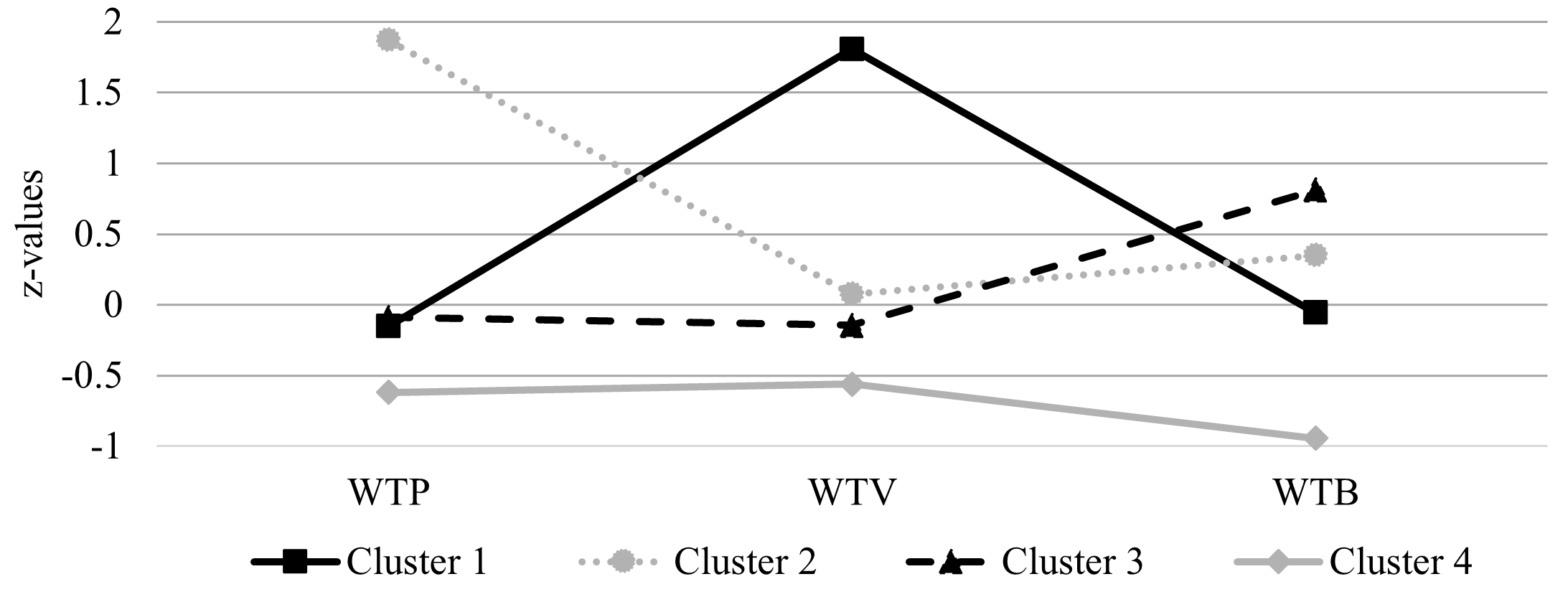
The comparisons of Eta², PRE and F-Max supported the four-cluster solution (Schendera, 2010). Split-half cluster solutions yielded the same interpretation regarding the number of clusters. The comparison of the initial four-cluster solution with the cluster assignments from the split-half method showed an almost-perfect agreement, indicating very good cluster stability (ARI = .95; Hair et al., 2018). All clusters differed significantly in terms of WTP (H(3) = 996.78, p < .001), WTV (H(3) = 761.33, p < .001) and WTB (H(3) = 1140.83, p < .001). The effect sizes ranged as .10 ≤ r ≤ .99 for WTP, .09 ≤ r ≤ .89 for WTV and .21 ≤ r ≤ .89 for WTB. The four resulting clusters could be meaningfully interpreted (see fig. 1 and Table tbl. 4):
Cluster 1: The members particularly willing to volunteer (12.2%)
Cluster 1 contained members who, compared to other members, were particularly willing to engage in voluntary work for their club’s climate policies. Since the homogeneity index for WTV within this cluster was rather low, it should be noted that, while these members had greater WTV than members of other clusters, their WTV still varied considerably. In terms of WTP and WTB, they showed an average willingness.Cluster 2: The members particularly willing to pay (14.8%)
Cluster 2 included members who, in comparison to others, were particularly willing to pay for climate policies. Again, the homogeneity index for this variable in this cluster was not very high, meaning that, while members exhibited above-average WTP, their WTP varied. Regarding WTV, they fell within the average range, while their WTB was slightly above average.Cluster 3: The members particularly willing to behave climate-friendly (35.0%)
Cluster 3 consisted of members averagely willing to support their club’s climate policies through financial contributions and voluntary work but particularly willing to engage in climate-friendly behaviour within club activities. This cluster exhibited relatively good homogeneity across all variables.Cluster 4: The below-average supporters of climate policies (37.4%)
Cluster 4 included members who were below average in their willingness to support their club’s climate policies across all three areas. On average, they were still willing to contribute a few CHF annually and dedicate almost a half-day to voluntary work. However, they showed relatively little willingness to engage in climate-friendly behaviour. This cluster also demonstrated satisfactory homogeneity values across all three variables.
External Cluster Validation
The clusters differed significantly in terms of age (H(3) = 120.57, p < .001, n = 1851), with members of cluster 3 being significantly younger than those of the other clusters (effect sizes between r = .08 and r = .28, indicating small to moderate effects according to Cohen, 1992). The association between gender and cluster allocation was also significant (χ2(6) = 98.15, p < .001, n = 1836) but rather weak (Cramér’s V = .16, p < .001). In cluster 3, there were significantly fewer men and more women, while more men and fewer women than expected were present in cluster 4. Furthermore, the clusters differed significantly in terms of environmental concern (H(3) = 583.70, p < .001, n = 1794): cluster 1 showed less environmental concern than clusters 2 and 3, with a small effect, and greater environmental concern than cluster 4, with a medium effect, while cluster 4 showed less environmental concern than clusters 2 and 3, with a strong effect. These results support the external validity of the clusters, especially of clusters 3 and 4.
Clusters | ||||||||||||
|---|---|---|---|---|---|---|---|---|---|---|---|---|
Cluster 1 The members particularly willing to volunteer (n = 229; 12.2%) | Cluster 2 The members particularly willing to pay (n = 279; 14.8%) | Cluster 3 The members particularly willing to behave climate-friendly (n = 669; 35.0%) | Cluster 4 The below-average supporters of climate policies (n = 704; 37.4%) | |||||||||
M | SD | homokj | M | SD | homokj | M | SD | homokj | M | SD | homokj | |
WTP (CHF) | 12.85 | 13.70 | .43 | 49.70 | 14.17 | .39 | 13.99 | 9.27 | .74 | 4.35 | 7.59 | .82 |
WTV (half-days) | 5.98 | 1.87 | .20 | 2.25 | 1.81 | .26 | 1.77 | 1.26 | .64 | .88 | 1.14 | .70 |
WTBa | 3.12 | .90 | .32 | 3.56 | .92 | .30 | 4.07 | .57 | .73 | 2.15 | .65 | .65 |
M = mean; SD = standard deviation; homokj = homogeneity index; homokj > .70 = good homogeneity (Bacher et al., 2010; Schmitt, 1996)
1 CHF = 1.02 Euro (09.05.2024)
a (5-point Likert scale; 1 = ‘does not apply’ to 5 = ‘fully applies’)
Comparison of the Clusters
The clusters differed significantly in terms of members’ club identification and subjective club norms (see Table tbl. 5). Members of cluster 4 identified more strongly with their club than those in cluster 3. Cluster 1 showed stronger club identification than clusters 2 and 3. Regarding subjective club norms, clusters 1 and 3 had slightly higher values than cluster 4. There were no significant differences between the clusters regarding subjective social status or whether the members currently worked voluntarily for the club and – if so – how many hours they volunteered in the last year.
Clusters | |||||||||||||||||||||
|---|---|---|---|---|---|---|---|---|---|---|---|---|---|---|---|---|---|---|---|---|---|
Cluster 1 The members particularly willing to volunteer (53 ≤ n ≤ 229) | Cluster 2 The members particularly willing to pay (49 ≤ n ≤ 279) | Cluster 3 The members particularly willing to behave climate-friendly (148 ≤ n ≤ 669) | Cluster 4 The below-average supporters of climate policies (155 ≤ n ≤ 704) | ||||||||||||||||||
M | SD | M | SD | M | SD | M | SD | F | pc | f d | Post-hoc tests | ||||||||||
Club identificationa | 3.29 | 1.06 | 3.02 | 1.02 | 2.91 | .99 | 3.16 | 1.06 | 10.66 | < .001 | .13 | 1–2, 1–3, 3–4 | |||||||||
Subjective club normsa | 3.53 | .89 | 3.42 | .87 | 3.46 | .80 | 3.33 | .84 | 4.50 | .004 | .09 | 1–4, 3–4 | |||||||||
Subjective social statusb | 6.58 | 1.45 | 6.79 | 1.44 | 6.69 | 1.38 | 6.56 | 1.42 | 2.17 | .090 | .06 | ||||||||||
Q1 | Mdn | Q3 | Q1 | Mdn | Q3 | Q1 | Mdn | Q3 | Q1 | Mdn | Q3 | H(3) | pc | ||||||||
Current amount of voluntary hours | 27.50 | 50.00 | 100.00 | 20.00 | 60.00 | 100.00 | 21.00 | 42.50 | 80.00 | 30.00 | 50.00 | 100.00 | 2.61 | .46 | |||||||
% yes | % yes | %% yes | % yes | χ2(3) | pc | ||||||||||||||||
Current voluntary work in the club | 24.89% | 17.92% | 22.57% | 23.01% | 4.56 | .207 | |||||||||||||||
a Likert scale from 1 = ‘does not apply’ to 5 = ‘fully applies’
b Scale from 1 = ‘lowest’ to 10 = ‘highest’
c Bonferroni-adjusted α = .01
d Effect size f: .1 = small, .25 = medium and .4 = large effects according to (Cohen, 1988)
Discussion
Most examined SAC members would be willing to pay for their club’s climate policies, volunteer and/or behave climate-friendly. The reported annual WTP is comparable to that of German sport club members in predominantly team-sport contexts such as basketball, football, handball, ice hockey and tennis (23.72 CHF vs 22.59 Euros, 65.5% vs 64.3% reporting a positive WTP; Thormann & Wicker, 2021b). SAC members express similar WTP for climate action as German football and track and field club members did for overcoming financial difficulties or service quality improvements (27.84 Euros; Wicker et al., 2018), but a lower WTP than that reported for general club memberships across various sport clubs (126 Euros; Swierzy et al., 2018; resp. 265 Euros; Wicker, 2011), including mountain sport clubs (110 Euros; Wicker, 2011). SAC members report a lower WTV for climate policies (65.9% and 3.07 half-days ≈ 13 h) than riding club members did for overall quality improvement of the club (82.32% and 30.39 h; Kiefer, 2015) and football and track and field club members for overcoming financial difficulties or service quality improvements (80.4 h; Wicker et al., 2018). As an explanation, the value of volunteering may be considered less effective for climate action compared to quality improvement or overcoming financial difficulties.
Extending previous studies on WTP and WTB for sport club member climate action (Braksiek et al., 2021; Thormann & Wicker, 2021b), it was shown that members are not just willing or unwilling to support their club climate policies. Instead, the cluster analysis demonstrated either a particularly strong preference to pay, volunteer or behave climate-friendly or a generally below-average willingness across all areas. These different clusters might reflect different attitudes towards different types of support, such as perceived effectiveness or pleasantness (e.g. Braksiek et al., 2021).
Members less willing to support climate policies tended to perceive lower pro-environmental club norms than those particularly willing to support through volunteering or climate-friendly behaviour. This parallels the positive relationship between subjective norms regarding pro-environmental behaviour and WTB observed among sport club members (Braksiek et al., 2021) and in fields outside of sport (e.g. Greaves et al., 2013). Furthermore, less-willing members identified slightly more with their club than individuals who showed high willingness to behave in a climate-friendly way. A possible explanation could be that weaker club identification places less importance on club activities and therefore restrictions in favour of climate-friendlier behaviour are more willingly accepted (e.g. forgoing club tours that can only be done by car).
Members with above-average willingness in a specific area revealed an interesting result in the external cluster validity assessment. Members particularly willing to volunteer tended to have somewhat lower levels of environmental concern compared to members especially willing to pay or behave climate-friendly. However, they also showed stronger club identification than the latter. This raises the question if the measured WTV reflects general rather than specific WTV for climate policies, as club identification has been shown to be a strong predictor of general volunteering (e.g. Schlesinger & Nagel, 2018).
Finally, aspects related to member resources (i.e. current club volunteering and subjective social status) did not differ between clusters. Previous studies reported a positive relationship between current voluntary working hours and WTV (support for club financial problems or quality improvements; Kiefer, 2015; Wicker et al., 2018). These results thus support intention to continue voluntary work as a stable construct, also including support for climate policies (Cuskelly & Hoye, 2013; Wicker et al., 2018). The role of subjective social status adds to studies analysing objective measures of socio-economic status, which show mixed results on the role of income and educational level for WTP and WTV in sport clubs (Kiefer, 2015; Orlowski & Wicker, 2016; Swierzy et al., 2018; Thormann & Wicker, 2021b; Wicker, 2011; Wicker et al., 2018). In contrast to assumptions regarding WTV as a potential alternative to WTP in case of scarce financial resources (e.g. Abramson et al., 2011), this study suggests that high WTV for climate policies is more strongly linked to factors such as club identification.
Limitations
The distribution of our survey has implications for the interpretation of results. The survey may have primarily drawn members with particularly positive or negative opinions about sport club climate action. As a result, descriptive values for WTP, WTV and WTB, as well as cluster sizes, should be interpreted with caution. Additionally, other clusters may have remained undiscovered. However, the key findings – that there are different clusters of members regarding willingness and that these differ in terms of club identification and subjective club norms – should remain valid.
In the present study, self-reported willingness rather than actual behaviour was measured. A main limitation of the CVM is the hypothetical bias, where individuals may, for example, report more hours than they would actually volunteer (Carson et al., 2001; Walker & Mondello, 2007). To minimise this bias, information regarding implementation, time frame and payment vehicle was included. Furthermore, in comparison to the previous study on sport club member WTB (Braksiek et al., 2021), items measuring WTB were strongly oriented towards behaviour necessary for specific climate policy implementation discussed by the federation and clubs, minimising hypothetical bias. However, the extent willingness translates into actual behaviour remains an area for further research. Furthermore, social desirability may play a role for the responses, particularly within the SAC, which clearly communicates commitment to climate protection. Members may therefore have felt a normative expectation to express higher levels of willingness.
Regarding the wordings in the questionnaire, two further points should be noted. The questions measuring WTB asked specifically about behaviours that are necessary for the implementation of climate policies in SAC clubs. However, it can be assumed that reported WTB in the club context largely corresponds to WTB in general life (e. g. vegetarians are likely to choose vegetarian options also in club activities). In addition, the WTP question included the wording “assuming that every member would be expected to contribute financially”. This formulation may have encouraged some members to report a WTP due to perceived peer pressure rather than a genuine willingness to support climate policies.
Preliminary analysis showed that WTP, WTV and WTB were primarily influenced by individual rather than club-level factors. However, particularly in the case of WTB (p = .08; small to medium value; Hox, 2010), the influence of club characteristics – such as climate action communication from the club or club culture – cannot be entirely ruled out. Other sport settings have shown that environmental actions at the organisational level can encourage environmental behaviour of sport participants (Casper et al., 2017; Delia et al., 2024). Future studies should explore the role of clubs and federations in shaping member willingness to support climate policies, ideally incorporating a more diverse range of clubs and federations in the sample (e.g. representation from different language regions).
Regarding the result generalisability, it is important to mention that data were collected from club members of a nature sport federation, which might be more climate-conscious than others. Indeed, according to Bürgi et al. (2023), SAC clubs reported a stronger desire than other Swiss sport clubs to receive assistance with environmental protection initiatives, suggesting that members are both aware of and interested in contributing to these activities. Therefore, descriptive values should be transferred with caution to other sport types, and potential additional clusters cannot be ruled out. However, it seems valuable to consider different forms of willingness to support climate policies and account for various clusters of members. Furthermore, the SAC is one of the largest sport federations in Switzerland, with 90 % of its clubs having over 300 members, compared to only 8 % in the average Swiss sport federation (Lamprecht und Stamm Sozialforschung und Beratung, 2023). Club size may affect members’ willingness to support environmental initiatives in different ways. On the one hand, larger clubs can pool more resources and might implement initiatives more effectively, which may increase members’ willingness. On the other hand, the greater anonymity in larger clubs may reduce personal accountability and involvement, potentially decreasing willingness to support.
Conclusion
This study highlights the value of understanding sport club members' willingness to support climate policies as a combination of WTP, WTV, and WTB and analysing members’ willingness from a cluster-perspective. The findings have implications for practice. Club climate policies rely on various types of support (e.g. purchasing solar panels on WTP, organising climate action workshops on WTV, promoting public transport on WTB). The findings suggest offering diverse contribution options instead of imposing the same regulations on all members (e.g. an optional climate contribution, opportunities for volunteering or default vegetarian meals with opt-out choices). This allows members to contribute in ways aligning with their individual willingness, fostering a more comprehensive level of support. Additionally, the findings indicate that volunteers for climate policies can also be found among members who do not exhibit the highest level of environmental concern but have a strong club identification. A key practical question arising is how to motivate less-willing individuals. Future research should explore how willingness evolves over time, i.e. how members can transition between clusters or to new kinds of clusters.
The study’s findings may help sport clubs to contribute to climate action both within sport (e.g. reducing emissions from sport-related travel) and beyond (e.g. raising awareness). However, tackling climate change also requires systemic action beyond individual choices to address key drivers such as the fossil fuel industry.