Abstract
Research has established beneficial associations between 24-hour movement behaviors (i.e., sleep, physical activity, sedentary behavior) and academic performance. However, most studies have focused on individual behaviors, overlooking their interdependence. This cross-sectional study examined the relationship between 24-hour movement compositions and academic performance among college students. A total of 150 college students (M = 19.2 years, SD = 1.42; 70.7% female; 44.7% Hispanic) wore an accelerometer to obtain device-based estimates of 24-hour movement behaviors for seven full days. Cumulative grade point average (GPA) and standardized test scores (i.e., SAT) were collected from university records. Compositional linear regression models were computed, with adjustment for covariates (gender, age, race/ethnicity, self-reported general health status, year in school, and SAT). The overall movement composition was significantly associated with GPA. Sedentary behavior and moderate-to-vigorous physical activity (MVPA) were positively associated with GPA, whereas a negative association was observed for light physical activity (LPA). Replacing up to 20 minutes of LPA with sedentary behavior, sleep, or MVPA was associated with higher GPA. Additionally, substituting sleep with MVPA was associated with higher GPA. Findings suggest that college students’ movement compositions may be related to their academic performance. Longitudinal work is needed to pinpoint specific periods within the semester to better understand when each behavior is most important for academic performance.
Keywords
academic achievement, university students, compositional data analysis, sedentary time
Introduction
In recent decades, successful completion of a college education has increasingly become an integral component in obtaining stable employment opportunities (Carnevale et al., 2010), ultimately fostering upward social mobility the United States (Adams et al., 2016). Furthermore, higher academic performance in college can facilitate more job opportunities (French et al., 2015), and plays a significant role in the hiring process, especially in applicants with limited work experience (Rynes et al., 1997). Given the important role academic performance can play in success in adulthood, it is important to identify factors correlated with academic performance to inform intervention development, especially for low-income and/or first-generation college students (Adams et al., 2016).
Previous research has established independent links between movement behaviors (i.e., sleep, physical activity, and sedentary behavior) and academic performance (Lederer et al., 2024; Okano et al., 2019; Wald et al., 2014; Wunsch et al., 2021). However, researchers have begun to adopt an integrative approach to examine the interactive influence of movement behaviors on various outcomes as movement behaviors are codependent whereby time spent in one behavior takes away from time that can be allocated to others (Pedišić et al., 2017). Recent meta-analytic results have demonstrated the importance of adopting an integrated approach to investigate movement behaviors in relation to academic performance among children and youth, as evidenced by the observed small effect (r = .17) between meeting all three components of the 24-hour movement guidelines and academic performance (Bao et al., 2024). In contrast, only one study has examined these relationships with college students. In a sample of 411 Canadian students, sleep guideline adherence was linked to higher grades, while adherence to sedentary guidelines was associated with lower grades; no significant grade differences were found for physical activity adherence (Pellerine et al., 2023). While this study investigated 24-hour movement guideline adherence, associations with academic performance were only examined independently, which fails to consider the collective influence of these behaviors. Further, examining adherence to threshold-based guidelines ignores much of the variability in movement behaviors through binary categorization.
Compositional data analysis (CoDA) is a statistical approach that takes into account the constrained nature of 24-hour time-use data by recognizing that each component of the composition is mutually exhaustive and exclusive (Pawlowsky-Glahn & Buccianti, 2011). Because time within a day is finite, increases in one behavior (e.g., physical activity or sleep) must necessarily come at the expense of time spent in other behaviors (e.g., sedentary behavior), making it inappropriate to examine movement behaviors independently when considering their relationship with outcomes such as academic performance. Methodological work has shown that adopting a CoDA approach overcomes the potential issue of multicollinearity amongst movement behaviors when absolute time-use values are used in traditional statistical methodologies (Dumuid et al., 2018). From this perspective, evaluating the academic implications of increasing a behavior (e.g., physical activity) requires consideration of which behaviors are reduced to accommodate that change.
While CoDA techniques are commonly used in the field of behavioral medicine to examine 24-hour movement compositions in relation to health indicators (Brown et al., 2024; Groves et al., 2024; Kracht et al., 2024), their application to academic performance has seen limited attention. Ng and colleagues (2021), using data from the CheckPoint study, found positive and negative associations for sedentary time and LPA in relation to academic performance, respectively, among a sample of 931 Australian adolescents. They also found that reallocating time from LPA to sedentary time was beneficial for academic performance. Another study by Watson and colleagues (2020) combined data from CheckPoint study with the Australian arm of the cross-sectional International Study of Childhood Obesity, Lifestyle and the Environment, increasing their sample to 1,234 Australian youth. They observed that more time spent in LPA, at the expense of other behaviors, was associated with poorer academic performance. Collectively, these findings demonstrate which behaviors may hold promise for improving academic performance, however, future work is needed to examine the replicability of these results and generalizability to other samples (e.g., college students).
Emerging adulthood represents a critical developmental period marked by increased autonomy over daily time use, including sleep, physical activity, and sedentary behaviors (Nelson et al., 2008). Unlike children and adolescents, college students must independently balance academic demands, coursework, employment, and social activities, resulting in substantial variability in how time is allocated across the day. These self-regulated time-use decisions are particularly relevant for academic performance in college settings, where sustained attention, studying, and cognitive endurance are central to success (Thibodeaux et al., 2017; Wolters & Brady, 2021). Although a growing body of 24-hour movement behavior research examining academic success has focused on children and adolescents, far less work has investigated these relationships among college students, despite the unique developmental stage of emerging adulthood and the self-directed academic demands of college (Nelson et al., 2008). Understanding how daily movement compositions relate to academic performance during this period may inform campus-based health promotion efforts by highlighting academic, in addition to health, benefits of movement behaviors.
The purpose of this study was to (1) examine the relationship between device-assessed 24-hour movement compositions and academic performance among college students using CoDA, and (2) determine the influence of reallocating time between movement behaviors (i.e., MVPA, LPA, sedentary behavior, and sleep) on academic performance. Based on previous literature (Felez-Nobrega et al., 2018; Ng et al., 2021; Okano et al., 2019; Pellerine et al., 2023), it was hypothesized that sedentary behavior and sleep would be positively associated with academic performance, whereas negative and null associations would be observed for LPA and MVPA, respectively. Additionally, it was hypothesized that replacing MVPA or LPA with sleep or sedentary behavior would be associated with favorable benefits for academic performance (Ng et al., 2021).
Methods
Participants and Procedure
A convenience sample of 150 participants (Mean age = 19.2 ± 1.42 years) was recruited from an introductory psychology participant pool at a large Hispanic-serving institution in the Southwestern United States (Porter et al., 2024). The student body of this institution includes 45% of first-generation college attendees and more than 40% of students who are Pell Grant eligible, which are awarded to those demonstrating significant financial need (Porter et al., 2024). The sample was primarily female (70.7%) and Hispanic (44.7%). Full sample descriptive statistics can be found in Table tbl. 1.
Variable | Number (N = 150) | Percentage |
|---|---|---|
Gender Male Female Other | 43 106 1 | 28.7% 70.7% 0.7% |
Race/ethnicity White Asian Black Hispanic Multi-ethnic Other | 27 15 12 67 26 3 | 18.0% 10.0% 8.0% 44.7% 17.3% 2.0% |
General Health Excellent Very Good Good Fair Poor Missing | 13 46 63 21 5 2 | 8.7% 30.7% 42.0% 14.0% 3.3% 1.3% |
Year Freshman Sophomore Junior Senior Missing | 93 38 11 6 2 | 62.0% 25.3% 7.3% 4.0% 1.3% |
This cross-sectional study was part of a larger project designed to examine correlates of physical activity behavior among college students. Data were collected during the Spring 2023 semester. While 376 students participated in the larger project, only 159 consented to access their university records, and 150 had valid accelerometry data, and therefore met inclusion criteria, comprising the analytic sample for this study (N = 150). All participants completed an online survey in which they first provided consent, which also included consenting for the research team to obtain their SAT/ACT scores, and GPAs from university records, followed by a series of questionnaires (see Porter et al., 2024 for more details about the larger project). After the survey, participants attended a research lab on campus to receive an accelerometer to wear for nine days. Participants received course credit as compensation. Study procedures were approved by an Institutional Review Board. This manuscript followed CoDA reporting recommendations outlined by Brown et al. (2024).
Measures
Movement Behaviors
Movement behaviors were assessed using ActiGraph GT3X+ triaxial accelerometers (ActiGraph Corp., Pensacola, FL, USA). Participants wore the accelerometer on their non-dominant wrist continuously for nine days, only removing it for prolonged water exposure. The first and last days of the wear period were considered partial wear days and were excluded from our analyses. Accelerometer placement on the wrist was selected based on prior research demonstrating greater compliance in comparison to placement on the waist (Ellis et al., 2016). As described in Porter et al. (2024), accelerometers were initialized to sample at 30 Hz with idle sleep mode enabled and the subsequent data were downloaded using ActiLife (Version 6.13.5) in GT3X+ file format. Raw accelerometry data files were processed using the free open-source GGIR package (Version 2.9.0; Migueles et al., 2019; van Hees et al., 2024). Signal processing using the GGIR package was performed according to the default GGIR settings for autocalibration using local gravity as a reference (van Hees et al., 2014), detection of implausible values, and identification of non-wear time. Periods of non-wear time are imputed by default in GGIR whereby missing data is imputed by the average at similar time points on other days of the week for that participant (van Hees et al., 2013). Average daily time spent in MVPA, LPA, and sedentary behavior was computed using the Hildebrand et al. (2017) cut points for segmenting levels of intensity among adults wearing an ActiGraph device on their non-dominant wrist: sedentary behavior (<44.8 milligravitational [mg] units), LPA (44.8 – 100.59 mg), MVPA (≥ 100.6 mg). These cut points were selected because they were developed and validated for adults wearing wrist-mounted ActiGraph devices and have been widely applied in college student and emerging adult samples, supporting their appropriateness for the present population (Gall et al., 2022; Martinez-Avila et al., 2020; Porter et al., 2024). A polysomnography-validated accelerometer algorithm was used to calculate average daily sleep duration (van Hees et al., 2018). Time-based estimates were averaged across all valid days for the 24-hour movement composition. The measurement day was determined from each measurement day’s wake time to the next measurement day’s wake time (i.e., wake-to-wake). Two inclusion criteria were specified to be considered valid accelerometry data: 1) a valid day was defined as at least 16 hours of accelerometer wear; and 2) a valid sample was defined as having ≥ 1 valid day (Porter et al., 2024). No specific restrictions were made regarding sleep duration.
Academic Performance
Institutional cumulative GPAs were collected from university records at the end of the semester (Spring 2023) and used as an estimate of academic performance. College GPA ranged from 0 to 4.0, with higher scores indicating higher levels of academic performance.
Covariates
Covariates included gender, age, race/ethnicity, general health status, year in school, and a measure of general intelligence (SAT/ACT test scores). Gender, age, race/ethnicity, and general health status were self-reported by participants and were included based on previously established associations with 24-hour movement behaviors among college students (Brown et al., 2022). Year in school was included as a covariate to account for systematic differences in cumulative GPA across academic progression, as GPA reflects performance accrued over time and may vary as students advance through their degree programs, experience increasing academic demands, and adapt to the college environment (Lederer et al., 2024). SAT and ACT scores were collected from university records. ACT scores were converted to SAT scores as recommended by the College Board as ACT scores correlate strongly with SAT scores (r=.89; College Board, 2018). SAT scores were included as covariates as they have been shown to positively predict college GPAs (Coyle & Pillow, 2008).
Data Analysis
All analyses were performed in R (Version 4.3.2) and R Studio (Version 2022.12.0+353). Descriptive statistics and frequencies were computed for each variable. Missing data on covariates were imputed using multiple imputation using the mice and miceadds packages (Robitzsch & Grund, 2023; van Buuren & Groothuis-Oudshoorn, 2011). A total of 38 multiply imputed datasets were generated according to the recommendation that m should be greater than 100 times the highest fraction of missing information (38% for SAT scores; White et al., 2011). One of the 38 datasets generated was selected at random and used for analyses given that the subsequent package used for transforming data to perform compositional data analysis cannot handle multiply imputed datasets. When multiple imputation and full information maximum likelihood methods are not feasible for addressing missing data, single stochastic regression imputation (utilizing just one of the N multiply imputed datasets) is considered the next best alternative (Allison, 2001; Brown et al., 2021).
Consistent with prior 24-hour movement behavior and academic achievement research (Ng et al., 2021), sleep, sedentary behavior, LPA, and MVPA were treated as mutually exclusive and collectively exhaustive components of daily time use and modeled as a four-part composition. Next, CoDA was conducted using the compositions package (van den Boogaart et al., 2023). Average minutes of LPA, MVPA, sedentary behavior, and sleep across all valid days were calculated, and then linearly adjusted to sum to 1440 min (24 hours). Next, the compositional variation matrix was calculated. The variation matrix describes the dispersion of the components within the composition and was derived by calculating the variation of the logarithms of all possible pair-wise ratios. Smaller values (closer to zero) indicate that the time spent between the two movement behaviors is highly co-dependent (Chastin et al., 2015), whereas larger values represent less co-dependency.
The next step involved transforming the absolute movement behavior data into relative values to reflect that the behaviors exist within a finite period (i.e., 24 hours), which was done by creating a set of isometric log-ratio (ilr) coordinates (Aitchison, 1982). Since ilr transformations cannot be performed with zero values in the data, the initial step involved examining each behavioral component of the four-part composition (i.e., sleep, sedentary behavior, LPA, MVPA) for any zero values. As there were no zeros in the data, we proceeded to create ilr coordinates using a sequential binary partition process (Egozcue & Pawlowsky-Glahn, 2005). The sequential binary partition was set up with the following ilr coordinates: (1) sleep vs sedentary behavior + LPA + MVPA, (2) sedentary behavior vs LPA + MVPA, (3) LPA vs MVPA. To address Aim 1, a compositional multivariate analysis of covariance model was computed to examine whether the daily composition was associated with academic performance. Next, three additional sets of ilrs were constructed, with each set treating a different movement behavior as the primary variable of interest. Using the four sets of ilrs, a series of multiple linear regression models (one for each set of ilrs) were computed to examine the associations between each movement behavior (relative to the remaining behaviors) and academic performance. The regression coefficients and standard errors for the first ilr coordinate for sleep, sedentary behavior, LPA, and MVPA are presented. All analyses were adjusted for covariates. The assumptions of linearity, homogeneity, and normality were assessed using the performance package (Lüdecke et al., 2021), and all assumptions were met for each model.
For Aim 2, the deltacomp package (Stanford & Dumuid, 2022) was used to compute a series of 1-to-1 compositional isotemporal substitution models to assess the hypothetical influence on academic performance of reallocating 5 to 20 minutes of time across each pair of movement behaviors (e.g., sleep to MVPA, sedentary behavior to LPA, LPA to MVPA), adjusted for covariates. Compositional isotemporal substitution modeling estimates the relative effect of replacing time spent in one behavior with an equivalent amount of time in another behavior (Dumuid et al., 2019). Beta coefficients and 95 % confidence intervals are presented. Statistical significance was set at p < .05.
Results
Missing data ranged from 1.3% for year/general health to 32% for SAT scores. Of the 150 participants who met the inclusion criteria for a valid accelerometry sample (n = 9 did not qualify), an average of 5.55 ± 1.83 valid days were recorded, with an average wear time of 1430 ± 64.4 minutes and an average non-wear time percentage of 6.90% ± 11.4. Participants’ average GPA was 3.21 ± 0.7, and their average SAT score was 1120 ± 138. On average, participants’ 24-hour movement composition was comprised of 10.6 hours of sleep (44.2% of the 24-hour period), 10.2 hours of sedentary behavior (42.5%), 2.2 hours of LPA (9.2%), and 1.0 hour of MVPA (4.2%) (Figure fig. 1). The variation matrix for the movement composition is presented in Table tbl. 2. Values closer to zero indicate higher codependence. For example, sleep and sedentary behavior exhibited high codependence (0.041), whereas MVPA showed lower codependence with sedentary behavior (0.574).

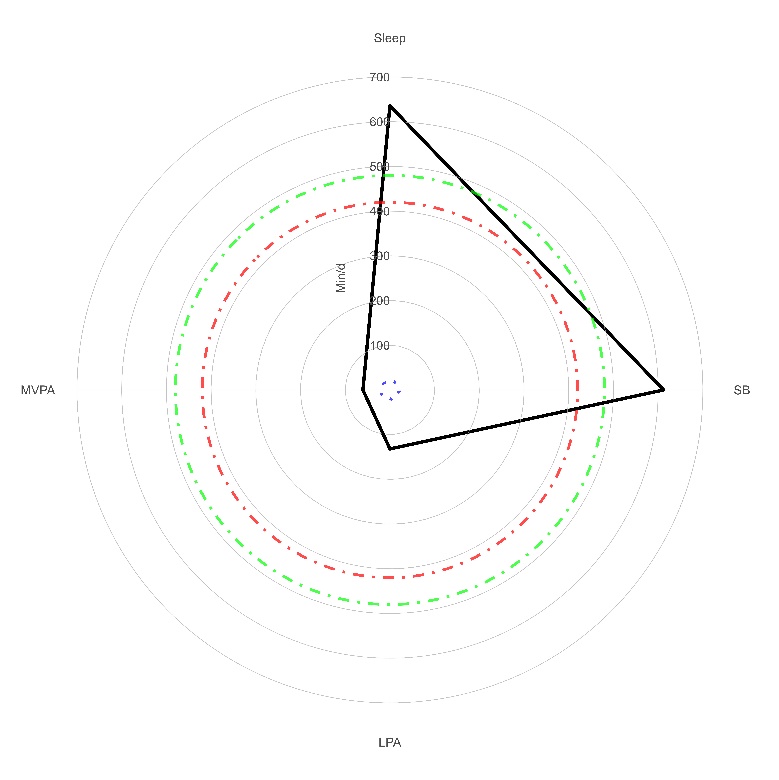
Time spent in sedentary behavior (SB), light physical activity (LPA), moderate-to-vigorous physical activity (MVPA), and sleep. The blue circle indicates the adult MVPA guideline (21 minutes/day or 150 minutes/week), the red circle indicates the lower bound of the sleep guideline (7 hours or 420 minutes), and the green circle indicates the sedentary behavior guideline (8 hours or 480 minutes).
Sleep | Sedentary Behavior | Light Physical Activity | Moderate-to-Vigorous Physical Activity | |
|---|---|---|---|---|
Sleep | - | |||
Sedentary Behavior | .041 | - | ||
Light Physical Activity | .283 | .342 | - | |
Moderate-to-Vigorous Physical Activity | .461 | .574 | .273 | - |
Aim 1
The daily time-use composition, adjusted for covariates, was significantly associated with academic performance; F(3,131) = 6.11, p < .001, explaining 11.2% of the variance (adjusted R2 = .112, i.e., a small to moderate effect) (Funder & Ozer, 2019; Gignac & Szodorai, 2016). When examining each behavior relative to the other behaviors, positive associations were observed between sedentary behavior (B = 0.71, SE = 0.34, p = .04) and MVPA (B = 0.27, SE = 0,13, p = .04) with academic performance, whereas a negative association was observed for LPA (B = -0.63, SE = -0.63, p < .001) and a null association was observed for sleep (B = -0.34, SE = 0.38, p = .37).
Aim 2
Compositional isotemporal substitution modeling revealed that reallocating up to 20 minutes of LPA to sedentary behavior, sleep, or MVPA (B = 0.02 – 0.15, ps < .05) was associated with significantly higher academic performance. Moreover, substituting up to 20 minutes of sleep with MVPA was also associated with significantly higher academic performance (B = 0.02 – 0.74, ps < .05). Other reallocations across behaviors were non-significant (p > .05). Results are presented visually in Figure fig. 2.

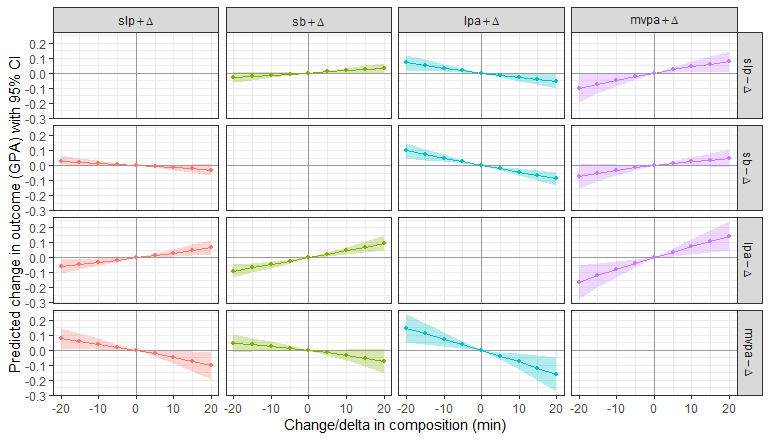
Estimates reflect hypothetical reallocations of 5–20 minutes between behaviors while holding remaining behaviors constant. SLP = sleep; SB = sedentary behavior; LPA = light physical activity; MVPA = moderate-to-vigorous physical activity.
Discussion
The purpose of this study was to examine the relationship between device-assessed 24-hour movement compositions and academic performance among college students and determine the hypothetical influence of reallocating time between movement behaviors. Students’ daily time-use composition was significantly associated with academic performance in college. Although the overall model explained 11.2% of the variance in GPA, this magnitude is notable in the context of academic performance, which is shaped by numerous cognitive, psychological, and socioeconomic factors that are not easily modifiable (S. D. Brown et al., 2008; Coyle & Pillow, 2008; Minnigh et al., 2024; Richardson et al., 2012). In this context, identifying daily time-use behaviors, including physical activity, sedentary behavior, and sleep, as contributors to academic performance is meaningful given their central role in students’ daily routines. Notably, positive associations were observed between sedentary behavior and MVPA with academic performance, whereas a negative association was found for LPA and a null association for sleep. Replacing up to 20 minutes of LPA with sedentary behavior, sleep, or MVPA was associated with higher academic performance. Moreover, reallocating up to 20 minutes of sleep with MVPA was also associated with higher academic performance. Findings from the current study suggest daily time use behaviors may be an intervention target for improving academic performance among college students, but more work is needed to test the causal nature of these relationships.
While prior studies have established independent links between movement behaviors and academic performance, this study considers their interdependence using CoDA. As hypothesized, there was a significant association between the movement composition and academic performance. The present findings build on previous research of Pellerine and colleagues (2023) through moving beyond examining threshold-based guideline adherence and the use of device-based estimates of physical activity, sedentary behavior, and sleep. Important differences emerged upon closer inspection of the individual behaviors. Specifically, a positive association was observed between sedentary behavior and academic performance, which aligns with previous research by Pellerine and colleagues (2023). This finding aligns with expectations, as sedentary activities like studying and attending lectures are often performed in stationary postures (Felez-Nobrega et al., 2018). Contrary to our null hypothesis, MVPA was also positively associated with academic performance. This finding does, however, support accumulating evidence demonstrating favorable associations between MVPA and academic performance among college students (Lederer et al., 2024; Wald et al., 2014; Wunsch et al., 2021). Previous work has shown MVPA is positively linked to cognition, which is understood to drive learning, memory, and ultimately, academic performance (Cox et al., 2016; Gomez-Pinilla & Hillman, 2013). In college settings, MVPA may be accumulated through structured or discretionary activities, such as recreational facility use, intramural sports, or active transportation across campus, that can be flexibly scheduled around coursework (Keating et al., 2005). In contrast to the beneficial associations observed for MVPA, an inverse relationship was found for LPA and academic performance. This finding is consistent with previously observed CoDA results among adolescents (Ng et al., 2021; Watson et al., 2020). In college populations, LPA likely reflects a heterogeneous set of activities, including commuting, occupational tasks, and non-academic social activities. Because these contexts were not directly assessed in the present study, the observed association should be interpreted cautiously; time spent in some forms of LPA may displace time devoted to academically relevant behaviors. Future research incorporating contextual information is needed to better distinguish which forms of LPA are most relevant for academic performance.
Sleep is believed to play a crucial role in memory consolidation (Diekelmann & Born, 2010), thus potentially enhancing academic performance among college students. However, this notion was not supported in the present study. Contrary to our expectations and previous research, we did not find a significant association between sleep duration and academic performance relative to other behaviors. One potential explanation for this null effect is sleep measured via accelerometry (measured by wrist immobility) is more of a reflection of time in bed and commonly overestimates sleep periods as sleep will often occur well after a period of wrist immobility (Marino et al., 2013). This may mean that sleep was overestimated in the present study at the expense of sedentary behavior. Research has also shown that accelerometry has reduced validity for assessing sleep-wake patterns in individuals with poor sleep quality, which is a common issue among college students (Owens et al., 2017). Together, these limitations may partly explain why students' sleep durations exceeded recommendations. Furthermore, other sleep metrics such as sleep quality and consistency have been shown to be stronger predictors of academic performance than sleep duration but were not assessed in the current study (Okano et al., 2019). Using alternative sleep assessment methods, such as at-home research-grade sleep devices (e.g., Zmachine) or commercial wearable devices (e.g., Fitbit), is becoming increasingly common in research and enables the assessment of sleep duration in conjunction with additional sleep metrics, including indicators of sleep quality (e.g., wake after sleep onset, sleep onset latency, and sleep efficiency), sleep regularity, and sleep staging, thereby improving measurement precision in future studies (Bianchi, 2018; Chinoy et al., 2022).
While significant associations with academic performance were observed for several individual movement behaviors (relative to others), it is important to recognize which behaviors time should be reallocated to (or away from) to optimize students’ grades. Findings from our isotemporal substitution models suggest that students should look to replace time spent engaging in LPA with MVPA, sedentary behavior, or sleep to improve their academic performance. These substitutions align with previous research that suggests MVPA and sleep support memory consolidation and time spent studying (sedentary behavior) can aid in memory formation and improve academic performance (Felez-Nobrega et al., 2017; Okano et al., 2019). Despite sedentary behavior often being associated with negative health outcomes, it can play a beneficial role in academic settings. Further, prioritizing MVPA at the expense of sleep also appears to be beneficial for grades among this sample, which may be a reasonable approach considering sleep duration exceeded the recommendation for this age group. Associations observed in this sample should be interpreted within the context of U.S. higher education, where academic demands, sedentary study time, and structured coursework may differentially shape relationships between movement behaviors and GPA compared to other educational systems. Collectively, our findings provide insight into the trade-offs between time spent engaging in different behaviors over the course of the day as they relate to students’ grades. Importantly, these isotemporal substitution estimates reflect hypothetical, non-causal reallocations of time and should be interpreted as providing preliminary insight rather than evidence of intervention effects. This information may help inform campus-based health promotion campaigns by highlighting potential trade-offs between behaviors relevant to academic success.
Behavioral interventions on campuses have traditionally focused on addressing behaviors in isolation, such as campaigns designed to increase physical activity or improve sleep quality (Haverkamp et al., 2020; Saruhanjan et al., 2021). However, focusing strictly on one behavior may be insufficient as movement behaviors are co-dependent and thus have an interactive influence on academic performance (Chastin et al., 2015). From this perspective, promoting a single behavior neglects the fact that increasing time in one behavior inevitably results in less time available for other behaviors. Adopting an integrative “whole day” intervention approach is therefore worth considering and our isotemporal substitution findings highlight certain behavioral trade-offs that can be targeted. For example, our estimates suggest an intervention aiming to replace LPA with MVPA may be most promising for improving academic performance. However, the feasibility, cultural appropriateness, and potential barriers or facilitators of such time reallocations were not assessed in the present study and will be important considerations for future intervention development in diverse campus settings. From a policy perspective, these findings suggest that student health promotion initiatives may have relevance beyond physical and mental health outcomes and could be integrated into broader academic success strategies. Even relatively small shifts in daily time allocation may yield meaningful cumulative benefits when applied across large student populations. Moving forward, collaboration between campus health services and academic researchers can help develop a more comprehensive understanding of the relationship between movement behaviors and academic performance via longitudinal designs, which is becoming more feasible with the increased use of commercial wearable devices (e.g., Fitbit) that can provide data over longer periods.
While this study has many strengths such as the use of device-assessed movement behaviors and consideration of the co-dependent nature of movement behavior data within a compositional framework, it is not without limitations. First, relying solely on accelerometer-measured sedentary behavior lacks context, as it cannot differentiate between time spent studying and recreational activities like watching TV or playing video games (i.e., active versus passive sedentary pursuits). Future research should gather contextual information about movement behaviors by using sensor-based triggering of ecological momentary assessment prompts in combination with accelerometers. Second, this analysis was conducted as part of a secondary analysis of a larger study focused on correlates of physical activity behavior, which constrained the availability of potential confounding variables. As a result, important academic and contextual factors, such as academic workload, employment hours, and time spent studying, were not measured, and could not be included as covariates. Although year in school and self-reported general health were included to partially address these concerns, future studies would benefit from more comprehensive assessment of academic and contextual influences on GPA. Third, convenience sampling was employed, and the sample was restricted to psychology students at a single Hispanic-serving university in the Southwestern United States, which may limit generalizability to students in other academic disciplines, institutional contexts, or educational systems. Fourth, it is important to note that our study utilized a cross-sectional design, which does not offer insights into causality or the temporal directionality of the observed associations. Longitudinal work is needed to pinpoint specific periods within the semester, such as midterms or finals, to better understand when each behavior is most important for academic performance. Finally, this study only assessed sleep duration in relation to academic performance. Other sleep metrics such as sleep quality and consistency have been shown to be stronger predictors of academic performance than sleep duration and deserve attention in future studies (Okano et al., 2019).
Conclusion
Overall, the findings from the present study suggest that college students’ movement compositions may be related to their academic performance when adopting an integrative 24-hour approach. Sedentary behavior and MVPA were linked with better academic performance, whereas time spent engaging in LPA may detract from student performance. Reallocating time from LPA to sedentary behavior, sleep, or MVPA appears to have potential for optimizing academic performance. Although more longitudinal work is needed to better understand these relationships, these findings suggest campus-based campaigns seeking to improve academic performance should consider recognizing the importance of all movement behaviors students engage in over the course of a whole day as opposed to isolated approaches focused on individual components of a 24-hour period.